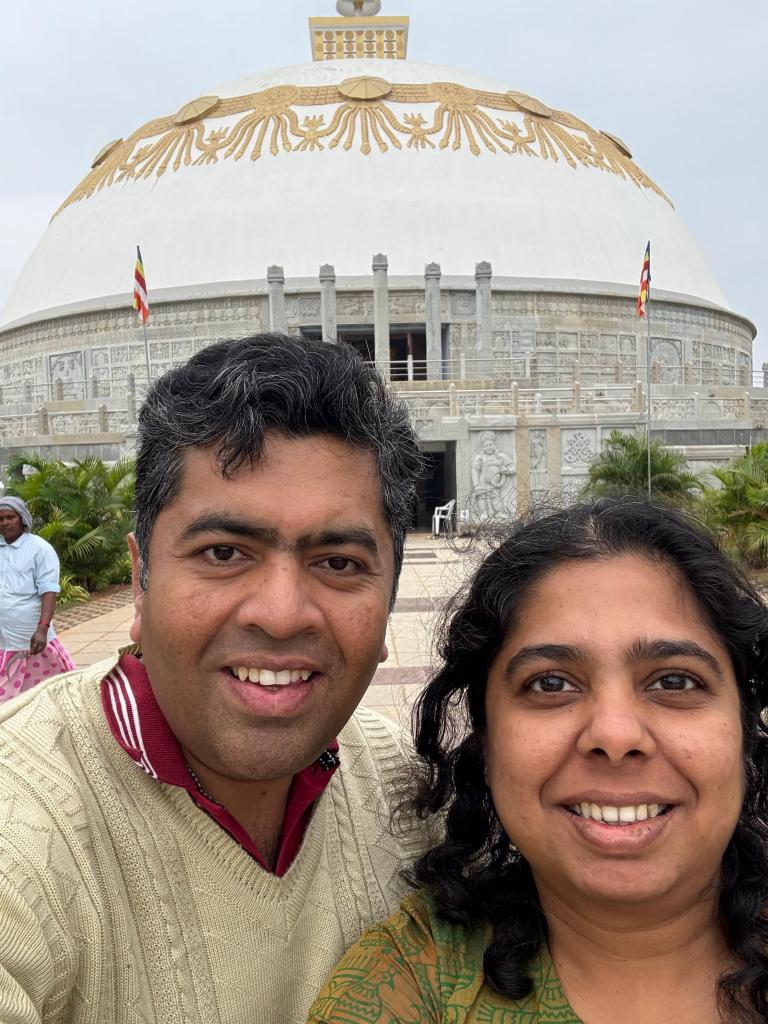
The magic of Buddhavanam

It is night, and as I sit in the verandah, I hear the buzz of crickets. Silence envelops the Haritha Vijay Vihar resort like a majestic shroud. Twenty feet away, the vast expanse of the Nagarjuna Sagar lake begins. Swapna is insde the room working on her laptop, while I try to get down to serious writing. Let me start with the events of today.

I wake up at 8 for a walk. The cool breeze, tall trees and leaf-lined roads provide the perfect excuse to step out for a date with nature and restart my exercise routine.

Kishore, the auto-rickshaw driver we appointed to ferry us around, is on time. He was planning to come earlier, but I ask him to defer the day’s sightseeing by a couple of hours, as I had to complete some tasks. His enthusiasm and keenness to show us around Nagarjuna Sagar is refreshing.

Once we get inside the autorickshaw, Kishore drives us to see Buddhavanam, a Buddhist Heritage Park in a place called Sunkishala. Buddhavanam consists of a Maha Stupa, 42 metres in diameter, at the centre, with other architectural tributes to Buddhism around the main dome. The middle dome has two floors, with the upper floor housing a meditation room, whose tranquility is like a balm for stressed city dwellers. The intricately carved walls depict the Jataka Tales and other significant events of the Buddha’s life. 

Overwhelmed by the sheer size of Buddhavanam, Swapna and I decide to explore one more spot in detail, the Stupa Vanam. The Stupa Vanam consists of replicas of stupas from different parts of India and the world. In the India section, we see replicas of the Sanchi Stupa, the stupa at Sarnath, the one at Amaravati, and the stupa in Samath. Having walked for several hundreds of metres, we dread walking further. However, our shared love for history makes us forget our fatigue and continue with exploring. 

Adjacent to the Indian stupa replicas lie their counterparts from Pakistan, Afghanistan, Nepal, Tibet, Mayanmar, Cambodia, South Korea and Sri Lanka. The difference in architectural style of each stupa is apparent, helping us see how Buddhism and the local cultures interacted, fed off each other and produced a syncretic result. While the Pakistani and Afghani stupas showed the influence of Islamic architecture, those from Nepal & Tibet and Cambodia & South Korea had South Asina and Southeast Asian features. 

The Buddhavanam is a microcosm of Buddhist architecture and culture from different parts of the world. It helps you to compare the architectural styles of Buddhist structures, as they vary from state to state and country to country. The vast exhibit proves how popular and firmly entrenched Buddhism was in India for close to a millenium. It also showcases the spread of Buddhism outside India, made possible by rulers like Ashoka, Kanishka, and others. 

Food for the stomach, music for the soul

With Independence Day falling on a Friday, we realised that the weekend would get extended by a day. Having more time on our hands, we decided to binge-watch Borgen, play badminton, and read on the first two days of our three-day break. Sunday could be spent visiting the Indian Music Experience Museum at JP Nagar. Swapna had mentioned it to me earlier, and I was curious about what made the place special.

We began the day with my Tabla class at Malleshwaram. Swapna prefered to soak in the nature at the public park nearby as I drummed away under my Guru’s guidance. After an hour of practise, I was done and joined Swapna at the park. It was time for lunch, so we hurried to Halli Mane in an autorickshaw. Halli Mane, meaning ‘Village Home’ in Kannada, is a popular restaurant serving South Indian food in the heart of Malleshwaram. Eager to relish the tasty food, we bought ourselves a special weekend meal each. As expected, we were served a rich variety, from a welcome drink, starters, five types of main course, and three kinds of dessert. We ate to our heart’s content because, after all, it is not everyday that we get to eat good food.

After lunch, our expedition to the Indian Music Experience Museum began. Located at JP Nagar, the museum begins by highlighting the music in our everyday lives – the chirping of crickets and birds to the noise of busy roads. It then takes you through the history of Indian music, starting from the first hymns in the Sama Vedas composed two thousand five hundred years ago, their evolution into the Carnatic and Hindustani forms, the influence of Western and Persian music on Hindustani, to the rise of popular film music, and more. The 360 degree view of Indian music at the museum is a visual and auditory feast. Whether you are a professional or amateur, you are sure to find something about music that interests you.

Back home after the eye-opening visit to the Indian Music Experience Museum, Swapna, Amma and I ended the day the way we began the weekend – by watching one more episode of Borgen.

ADIEU, KARWAR

Today was the last day of our Karwar visit and our only chance to visit the Rock Garden & Warship Museum. As our bus was in the evening, we used the morning to explore these two places. 

Located on the Rabindranath Tagore Beach, the Rock Garden showcases the lives of Karnataka’s people. From Haliyal in the north to Bhatkal in the South, every tribe finds a worthwhile mention.

When you enter, a mural sculpted like a fisherman’s family celebrating a catch welcomes you. Further inside, you see sculptures of people farming, fishing, and animal rearing. They are so intricate and life-like that you feel they are talking to you, inviting you to be a part of their lives. Stone plaques with details provide a deeper understanding for the curious visitor.

The Warship Museum, located next to the Rock Garden, showcases the historic INS Chapal. Dummy guns and rocket launchers on the outside highlight the Navy’s firepower. The interiors, on the other hand, stand out for their rich detail. As you enter, mannequins dressed as the Captain, Sailors, and Doctors greet you. A TV room, a strategy room, a medical unit, and others recreate their lives, a blend of hardship, adventure, and fun. 

Once done with the sightseeing, we headed back to the resort. On the way, we bought Apples and Oranges for our trip home.

We boarded the bus back to Bangalore at 6. Reflecting on our stay, we felt grateful to have experienced a slice of Karwar’s rich history, culture, and natural beauty. With its pristine beaches and lush forests, Karwar is the perfect destination for travellers looking to unwind.

While researching before our visit, I remember stumbling upon some interesting information: Rabindranath Tagore describing Karwar as the ‘Kashmir of South India”. This description puzzled me then, but not anymore…..

SEASHELLS AND CALAMARI

Palolem Beach had left a deep impression on Swapna and me, so we decided to spend the day there. Like earlier, we boarded a bus to Canacona from Karwar and, upon reaching, walked down to Palolem Beach.

Since the sun was blazing, we postponed the swimming to the evening. But we wondered how we would spend the day. We then spotted reclining chairs under an umbrella outside a shack. This gave us an idea. We could spend the morning relaxing on them, soaking in the warm sun without overexposure. We requested the shack’s owner to let us use them, and, to our delight, he agreed. But he had a condition: we had to eat lunch at his restaurant. We agreed.

Soon, it was time for lunch. As I flipped the menu, I remembered Sandeep asking me to try Calamari. Calamari is a Konkani dish made by cutting squid into rings and then breading & frying them. Eager to experiment, I ordered it. Swapna was keen on prawns and ordered a plate. 

Cooked in cheese & corn flour and served with French Fries, the Calamari was delicious. I relished every bite as it melted in my mouth like butter. Swapna, seeing me enjoy the Calamari, felt a FOMO (a marketing term that stands for Fear of Missing Out). She liked them so much that she forgot about the prawns.

At 4, the sunlight faded. We entered the sea but limited ourselves to the shallow parts. The lifeguard on duty warned us against going too deep. Yet, even that experience was fulfilling as the water kissed our skin and rejuvenated us.

We spent the final hour at Palolem Beach shopping for necklaces made of sea shells. We wanted to gift Amma something authentic from Goa, and this was the perfect opportunity. We also bought some elephant-shaped fridge magnets, also made from sea shells.

DAY 3 AT KARWAR

We woke up late, feeling refreshed after the exhausting trip to Goa the previous day. We were hungry but wanted to find a cheaper option for food. Luckily, we discovered an Udupi restaurant next door and headed there for breakfast.

The dosas at the Udupi restaurant were crisp and golden brown. The cook had roasted them to achieve the perfect taste and colour without overusing oil, a testament to his skill and experience. Swapna and I relished the meal and ended it by sharing a plate of Kesari Bath.

After the meal, we returned to our room and decided to spend the morning at Tagore Beach, around five kilometres from Sterling. We had heard of the beach’s magnificent sunrise and were keen to witness it in person. Luckily, we found an autorickshaw driver.

Unfortunately, by the time we reached Tagore Beach, the blazing hot sun was out in full force, dashing our chances of a pleasant view. We ate quickly at a restaurant nearby and returned to the resort for a siesta. 

In the evening, we returned to Tagore Beach. This time, we were lucky. The quiet sunset, the sea, the clouds, and the cool breeze did wonders for our mood, uplifting our sagging spirits. We captured photographs of the setting sun in the background. We collected shells embedded within the sand, appearing whenever the water receded. 

After two hours at Tagore Beach, we returned to the resort. At the resort, we joined other tourists in watching a documentary on the US Navy. The film highlighted the massive sea, air, and stealth power of the United States, giving the audience an insider’s view of warships, aircraft carriers, destroyers, and reconnaissance submarines. 

Having spent most of the day outside, we returned to our rooms and went to bed, eagerly anticipating the adventures that awaited us the next day.

Day 2 at Karwar

We wanted to start the day with a visit to the beach and, having crossed the gate, found ourselves in a wooded area with a path. Nothing, not even a signboard, indicated where the path was leading. Doubtful we were on the right track, we followed a pack of dogs. Something told us that they would lead us to the beach. Sure enough, they did. 

The water was lower, separated from the road by an embankment. At intervals along the embankment, steps led to the water below. Delighted, I changed into my swimming trunks and began my descent. Oblivious to the moss on the steps, I slipped and fell with a thud. 

Fortunately, the fall was minor. My back ached a bit, but nothing broke. Also, I wouldn’t let the accident crush my spirit, so I gathered myself and entered the water slowly, finding a foothold quickly. The sand, pebbles, and shells tickled my feet. 

I was forced to cut my time in the water short. It was getting deep and dangerous, and I didn’t want to take any chances. 

Disappointed, Swapna and I returned to the resort. Luckily, we spotted an advertisement for a boat ride in the lobby. We contacted the boat owner and booked a slot for 9. 

The ride began on time. We had five forest officers for company who were on holiday just like us.

As we made our way through the choppy waters, the boat tilted to one side, spooking us. The boat owner, who knew the sea well, asked us to relax.  

Soon, the shore turned into a distant speck, shrinking in importance in contrast to the vast expanse of water. We saw dolphins swimming close to our boat, occasionally flying out of the water to breathe. A thrilled Swapna clicked their photographs, irreverent to the splashing water. 

During our hour-long sea ride, we got friendly with the boat owner. He advised us to visit Canacona in South Goa. 

The beach had a spattering of locals, tourists (primarily foreign), and shack owners. Children made castles in the sand as their parents basked in the warm sun. 

Eager to explore, Swapna and I walked down the beach. We saw several shacks dotting the area and entered one after a while.

The shack was sparsely populated, mostly with tourists. One was reading a book, taking advantage of his quiet surroundings.

It was time for lunch. We settled on a pair of recliners and scanned the menu. The wide choice of coastal cuisine was tempting. We couldn’t hold ourselves further, so we ordered Prawns Vindaloo and Chapati. We relished every bite, licking our fingers in delight. We ended the meal with Bebinca, a Goan dessert. Served with vanilla ice cream & chocolate sauce, it won our hearts.

After lunch, we settled on the recliners, facing the sea. As the warm breeze blew against us, we slept peacefully. When we awakened, it was evening. We returned to the resort on time for dinner. 

Seeing my tanned face, the staff at the resort asked with a smile, “Kahan ghoom ke aaye, saab?”

FIRST IMPRESSIONS OF KARWAR

After our whirlwind marriage in Hyderabad, Swapna and I were brimming with excitement for our upcoming honeymoon in Karwar. We were eagerly looking forward to the trip, hoping it would provide a much-needed respite after the hectic weeks leading up to our wedding.

As planned, we took a bus to Karwar on Tuesday, October 8. After a bumpy ride, we disembarked at the Karwar municipality the following day. We hired an autorickshaw and landed at Sterling. The staff applied tilak on our foreheads to welcome us. They knew we were newly married. 

The room was cosy, just perfect for the two of us. After a refreshing shower, we were eager to explore the local cuisine. I had heard so much about Karwar’s delectable fish dishes, and I was excited to try them. When I saw Pomphret on the menu, I knew I had to have it. The fish, marinated with chilli, salt & spices and shallow-fried, was a burst of flavour. With each bite, I could feel my fatigue melting away, replaced by a sense of rejuvenation. 

After lunch and a quick nap, we walked down to the reception. Nisha, a part of the support staff, invited us to a Karaoke event at the bar. Since Swapna and I were free that evening, we accepted the invite. 

Upon entering the bar, Nisha placed the mike in my hands. I didn’t want to play spoilsport, so I agreed to sing. 

It had been a good twenty-five years since I last sang, back in my school days. I certainly didn’t expect my voice to retain its youthful clarity. But as I stood there, singing in harmony with the lyrics on the screen, I felt a surge of inspiration. The singer in me had been reawakened.

After ending the day on a melodic note, Swapna and I had dinner. We then retired to the room, keenly anticipating our visit to the beach early next morning. The thought of the sun rising over the horizon, the sound of the waves crashing against the shore, and the feel of the sand between our toes filled us with excitement.

Mysore Diaries – Day 1

As I sit in my hotel room to record my first impressions of Mysore, I am unsure how to begin. Actually, these are not first impressions; my uncle, who loved traveling, visited Kodaikanal or Ooty with us and passed through Mysore often. As a result, I am familiar with tourist spots like the Brindavan Gardens, Krishnaraj Sagar Dam, and the Mysore Palace.

This time, I am with my mother for a conference on food security. She is going to speak on food fortification and its impact on livelihoods. Since the topic does not interest me, I plan to explore Mysore as she goes about lecturing.

But my travel will begin tomorrow, so I cannot say much about the places I am yet to explore. Yet, my ordeal with reaching the Bangalore railway station en route to Mysore this morning is worth mentioning. 

The Shatabdi Express to Mysore was due to leave Bangalore at 10.50 AM. Although my mother and I got ready in time by 9, finding an Uber wasted precious time. It took the app on my phone half an hour to allow a taxi and fifteen more minutes for the driver to pick us up. So we ended up leaving only at 9.45. The heavy traffic (something Bangalore is famous for) forced us to take an alternate route. This, coupled with the fact that the platform from which the train was to leave was unknown to us, made matters worse. And if you thought that was the end of our woes, you are mistaken. Majestic Railway Station, the point at which we were boarding the train, was jam-packed ahead of Prime Minister Modi’s scheduled visit. The BBMP, in a last-minute beautification frenzy, had blocked the entrance to the railway station. This forced passengers like us to disembark much before the station and walk for two hundred meters with luggage in our hands. My mother, aghast at the situation, argued with the taxi driver and local police.

I tried to keep my cool. At least I gave the impression that I was. So, upon reaching the platform, we got on to the nearest coach. We had no choice as the train was to leave any minute. Besides, the internal connection of all compartments made us feel confident. We had to cross seven coaches before we could arrive at ours. This took a while, but when we made it, both mother and son heaved a sigh of relief.