Featured

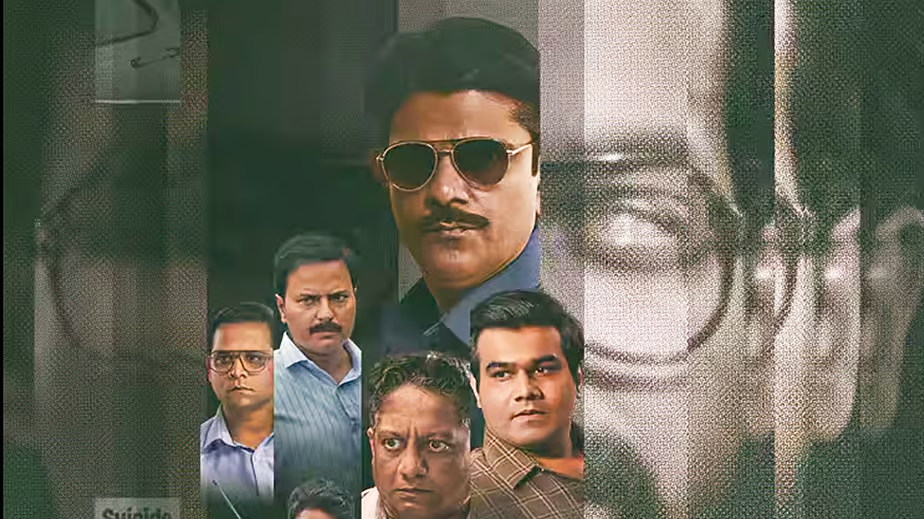
Why I liked Jaane Jaan

Set in the hilly tracts of Kalimpong, ‘Jaane Jaan’ is a movie about Maya D’Souza (Kareena Kapoor Khan), a single mother. When she is accused of murder, she finds unanticipated help from her neighbour, the socially inept but gifted Mathematics teacher Naren Vyas (Jaideep Ahlawat).S

Kareena Kapoor Khan, a seasoned actor, delivers a brilliant performance in a new role. She deftly plays Maya, the cafe owner struggling to make ends meet. While we are used to seeing her exude oomph, in Jaane Jaan, she manages to impress in a middle-aged avatar. Her grace wins her many admirers, most notably Naren. As a result, Naren visits Maya’s cafe often, more for her and less for the egg-fried rice.

Jaideep Ahlawat is terrific as the steely Naren Vyas. Lonely and depressed, he masks his unhappiness with dignity. He cannot articulate his fondness for Maya, whom he loves most after mathematics.

Vijay Varma shines as Inspector Karan Anand, the Mumbai police officer tasked with finding corrupt cop Ajit Mhatre’s killer. He is sharp and trained to look beyond the obvious. However, he is no match for the genius of Naren.  

Varma’s performance is noteworthy because he, being a newcomer to Bollywood, takes on Kareena Kapoor Khan, one of the industry’s most accomplished actors, with confidence. Also, while Karan is attracted to Maya, the movie doesn’t succumb to the temptation of melodramatising the two.

Jaane Jaan is also a story of the triumph of the human spirit against all odds. Naren and Maya, both waging a battle on their personal fronts, show the determination and courage to craft their destinies. While Maya is moving on after a messy marriage, the suicidal Naren finds in Maya a reason to live. Their never-say-die spirit is the thread that holds the story together.

Jaane Jaan is also noteworthy for its crisp narrative. There are no wasted scenes or unnecessary dialogues, and the makers brilliantly pull off a story around a murder cover-up.

What is also unique about Jaane Jaan is how it uses Mathematics to enrich the narrative. Right from Naren’s empathy for a struggling student, Naren’s tireless efforts to solve complex mathematics problems, and the clever use of the subject to obfuscate the truth, the power of mathematics is on full display.

The investigation into Ajit Mhatre’s murder hits a dead end. While Maya is let off due to a lack of evidence, Naren finds the right environment to pursue his passion for mathematics – jail.

What’s in a Name? Quite a Lot, Actually

When I was in college, I knew two other students who were my namesakes – Kanishko, from Kolkata, and Kanishk, from North India. My name, Kanishka, had a distinctly Telugu ring to it.

Because of the similarities in our names, teachers and students would get into muddles, especially in the first term. If Kanishko, a sports-lover, registered for a tournament I would be summoned for practice. If Kanishk skipped the Computer Science Lab, Kanishko got pulled up.

While studying creative writing at Symbiosis, one of my teachers called me ‘Kaniksha’, pronouncing the k before the s. I didn’t bother to correct her.

My friends in boarding school got creative with my name. Some called me ‘Kannu’, a name that inspired my Yahoo Email ID, while others went further, taking the liberty to sound vulgar.

I don’t mind people mispronouncing my name, as long as it is not intended to insult or hurt.

Almost Venkateshwarlu
There’s a funny story about how I came to be called Kanishka. It was 1984, and I was two. My parents had invited their friends home for dinner, and they all pleaded with them to name me. My parents, being staunch socialists, asked everyone present that day, including our cook, to write their choices on a piece of paper and drop it inside a box. My father was asked to pick up a chit from the lot, and then christen me with the name mentioned on it. When my father picked up the chit, he saw ‘Venkateshwarlu’, the name of a local God. Alarmed, he quietly placed the chit back in the box without anyone watching and picked up a second one. That chit had the name ‘Kanishka’.

The Perfect Robber

‘Bang’, went the gun inside the bank. Everyone – from the manager and cashier to the clerks and customers – froze in horror. For a moment, they were not sure what was happening. But within seconds, they saw the masked bank robbers and bent low to avoid the line of fire. By the time Joe, the man leading the robbers, reached the cashier, the terrified bank inmates had put their hands up and surrendered.

The Manager, who was in a separate room, remained seated on his chair, unsure about what to do next. He had half a mind to press the buzzer to alert the police, but seeing the loaded guns in the robbers’ hands, he dropped the idea.

While the bank robbery was a big, scary event in the lives of the staff and customers, it was business as usual for Joe Thomas. Joe had been robbing banks for the past twenty-five years. He began at the tender age of 15, when he accompanied his father, also a gangster, to a bank robbery in downtown New York. He had made an impact with his quick thinking and daring. After that day, there was no looking back.

Over the years, Joe robbed hundreds of banks without ever getting caught. His smooth technique and sharp execution helped him get away each time. When he was twenty-five, he fell in love with his neighbour, a girl called Mary. They dated for a couple of months and tied the knot with their families’ blessings. The couple had two children – Tom and Anita.

Joe’s family’s needs fuelled his bank robbing campaigns. He was born poor, and with little education, crime was the only way to make ends meet. The money he brought to the table fed his family, saw his children through school, and helped him own a plush car. As the years rolled on, Joe’s bank balance also rose, one bank robbery at a time.

When Joe touched 45, his children were grown. Anita had finished college, and Tom was settling into his job.

While the children were settling into adult lives, there was turbulence between Joe and Mary. Joe’s wife missed the young and athletic Joe she once knew. Years of struggle, seeing children through school, and caring for aged parents had sapped the romance out of their lives. Joe was a pale shadow of his former self, no longer capable of satisfying her emotionally, let alone physically.

It was a difficult time for Joe and Mary. While they loved their children, the latter were grown and capable of fending for themselves. The couple saw no reason to stay together and parted ways.

Their divorce was amicable to the extent that Mary did not demand alimony or a share in Joe’s property. Yet, the separation broke Joe’s heart. He was devastated by the turn his life had taken. For years, he believed he was doing everything right for Mary and the children. But the stress and responsibility of parenthood had blinded him to Mary’s real needs – love, affection, and physical intimacy.

All of a sudden, Joe found life was meaningless. His wife had left him, his children were too busy for him, and his parents were no more. He was lonely and longed for company. He fondly recalled the thrill he felt as a 20 year old as he rode his motorbike, impressing the girls in town with his swagger. He longed to return to those carefree years, when everything seemed possible and he was answerable only to himself.

Addiction: Creativity’s nemesis

When I was in the media, there were times when I could not write. I felt my creative juices fail me and struggled to express myself despite having something to say. That’s when a song that I learnt in school would come to my mind. Here are the lyrics:

“What shall we do with the drunken sailor?

What shall we do with the drunken sailor?

What shall we do with the drunken sailor?

Early in the morning.

Hooray, and up she rises.

Hooray, and up she rises.

Hooray, and up she rises.

Early in the morning.”

What’s the significance of this song in the context of writing? Very simply, it is the link between being a slave to an addiction and being unable to gather your thoughts and write.

During my media years, I was a smoker. This song served as a reality check whenever I faced writer’s block. It reminded me that if I wanted to perform at my peak, I would have to first work on quitting smoking.

All addictions are ultimately self-destructive. They gnaw at your confidence and self-worth and, over time, harm your performance at work.

Some theories claim that the best writers smoked up, that somehow, becoming dependent on drugs replenished their creative juices. Research has found that the best writers and artists did well despite, not because of, addictions.

Does anyone want to share their experience with an addiction? I’d love to know how you handled it, or whether you are still struggling with it.

Hyderabad to Moscow

As a boy of nine,
I longed to shine.

So I asked my mother if I could go abroad,
She said yes – provided I studied hard.

I would be the first in class to do so,
And the thought delighted me even more so.

I studied every day, without fail,
Though the effort often left me pale.

When my mother said my visa was granted,
I felt on top of the world – my joy unbounded.

You should have seen me when I landed in Moscow,
I stepped off the aircraft, feeling like a hero.

Confidence and swagger, personified,
And in feeling so, perhaps justified.

After fifteen days, I returned from afar,
Welcomed like a hero, feeling like a star.

That journey is one I’ll always remember,
Etched in my mind – forever and ever.

Captain Barbe Rouge – The Honourable Pirate

Captain Barbe Rouge was a man of principles. He neither misbehaved with women nor succumbed to temptations like drinking or smoking. True, he was a pirate, yet he never dishonoured the women aboard the ships he hijacked. Once, when a male member of his crew assaulted a woman prisoner, the Captain ordered him hung upside down and lashed fifty times in full public view. The man nearly died, but Captain Barbe Rouge remained unmoved. To him, dishonouring a woman was unforgivable.

His wife and children feared him for his unyielding moral standards. Once, when his teenage son was reprimanded for teasing girls in school, the boy begged the principal not to inform his father. He eventually confessed to his mother, who chose to keep the incident from the Captain.

Life at sea was long and lonely. When his crew gathered over bottles of wine to break the monotony, the Captain stayed away. Discipline, he believed, left no room for indulgence.

His children longed for affection from him. They respected him, but it was a respect born of fear rather than love.
There was also the matter of his estranged younger brother.

The Captain was the eldest of three siblings. When their father died, he was only twelve, yet the burden of the household fell squarely on his shoulders. He cared for his mother and raised his younger brother and sister. With little money to spare, he abandoned his education after Class 7 and joined the family business.

Those early sacrifices secured a modest middle-class life for his family, but they left the Captain embittered. He put his siblings through college while his own dreams withered. As a boy, he had wanted to become a doctor. Fate had other plans.

Throughout his life, he worked relentlessly to keep others comfortable. Everyone sought his advice, his help, his strength – but no one ever asked him if he was happy, or whether he wanted something for himself. Surrounded by family, he felt profoundly alone.

Piracy was never his ambition. It was desperation. After his father’s death, he was broke, and a friend suggested they hijack ships to survive. What began as necessity hardened into profession.

Years later, his younger brother – now a senior government official – was suspended for corruption. The Captain was enraged. Dishonesty was intolerable. Without hesitation, he banished his brother from the family. Even after the brother served a two-year prison sentence, the Captain refused forgiveness. Blood, to him, did not excuse corruption. The brother left and never returned.

Time passed. The Captain’s children grew up.

His daughter fell in love with a college classmate. After they settled into their jobs, she decided it was time to tell her family she wished to marry him.

But there was a problem.

The man she loved was the son of a politician who had served jail time for embezzling public money. Would the Captain accept such a man’s son into the family?

The magic of Buddhavanam

It is night, and as I sit in the verandah, I hear the buzz of crickets. Silence envelops the Haritha Vijay Vihar resort like a majestic shroud. Twenty feet away, the vast expanse of the Nagarjuna Sagar lake begins. Swapna is insde the room working on her laptop, while I try to get down to serious writing. Let me start with the events of today.

I wake up at 8 for a walk. The cool breeze, tall trees and leaf-lined roads provide the perfect excuse to step out for a date with nature and restart my exercise routine.

Kishore, the auto-rickshaw driver we appointed to ferry us around, is on time. He was planning to come earlier, but I ask him to defer the day’s sightseeing by a couple of hours, as I had to complete some tasks. His enthusiasm and keenness to show us around Nagarjuna Sagar is refreshing.

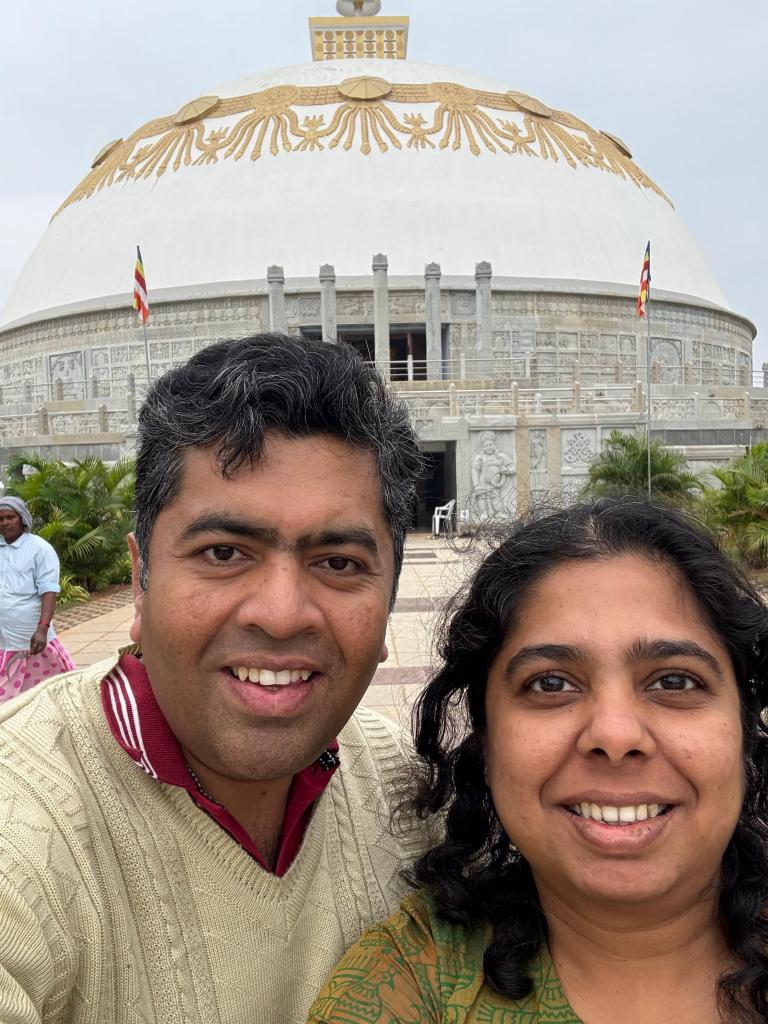
Once we get inside the autorickshaw, Kishore drives us to see Buddhavanam, a Buddhist Heritage Park in a place called Sunkishala. Buddhavanam consists of a Maha Stupa, 42 metres in diameter, at the centre, with other architectural tributes to Buddhism around the main dome. The middle dome has two floors, with the upper floor housing a meditation room, whose tranquility is like a balm for stressed city dwellers. The intricately carved walls depict the Jataka Tales and other significant events of the Buddha’s life. 

Overwhelmed by the sheer size of Buddhavanam, Swapna and I decide to explore one more spot in detail, the Stupa Vanam. The Stupa Vanam consists of replicas of stupas from different parts of India and the world. In the India section, we see replicas of the Sanchi Stupa, the stupa at Sarnath, the one at Amaravati, and the stupa in Samath. Having walked for several hundreds of metres, we dread walking further. However, our shared love for history makes us forget our fatigue and continue with exploring. 

Adjacent to the Indian stupa replicas lie their counterparts from Pakistan, Afghanistan, Nepal, Tibet, Mayanmar, Cambodia, South Korea and Sri Lanka. The difference in architectural style of each stupa is apparent, helping us see how Buddhism and the local cultures interacted, fed off each other and produced a syncretic result. While the Pakistani and Afghani stupas showed the influence of Islamic architecture, those from Nepal & Tibet and Cambodia & South Korea had South Asina and Southeast Asian features. 

The Buddhavanam is a microcosm of Buddhist architecture and culture from different parts of the world. It helps you to compare the architectural styles of Buddhist structures, as they vary from state to state and country to country. The vast exhibit proves how popular and firmly entrenched Buddhism was in India for close to a millenium. It also showcases the spread of Buddhism outside India, made possible by rulers like Ashoka, Kanishka, and others. 

‘Dhadak 2’ Review: A Bold, Unflinching Look at Caste 

Dhadak 2 is Shazia Iqbal’s Hindi adaptation of Mari Selvaraj’s Tamil film ‘Pariyerum Perumal’. It portrays an inter-caste couple’s fight against caste prejudice. 

Neelesh (Siddhant Chaturvedi), a Dalit student of law, has a simple and straightforward goal: to study hard, become a lawyer, and lift his family out of poverty. He avoids political activism, lest it derail his long term plans. He finds an empathetic friend in Vidhi (Tripti Dimri), who helps him understand the subject. And, like what happenes in most college friendships, theirs deepens into love.

Neelesh’s subservience and timidity get him nowhere: he is constantly reminded of his place in the caste hierarchy, whether in college or at social gatherings. Neither can he claim his right as a student, nor can he escape casteist taunts. 

His struggle is reminiscent of real-life Dalit students who paid the price for speaking out. The case of Senthil, the Dalit student in the University of Hyderabad who took his own life, comes to mind instantly. And when Shekhar (Priyank Tiwari), Neelesh’s contemporary in college and a fellow Dalit, resorts to the extreme step after being suspended for protesting, one cannot miss the resemblance with Rohit Vemula.

When his face is disfigured by upper caste students in college, the lion in Neelesh awakens. Siddhanth Chaturvedi plays Neelesh’s transformation into a confident and assertive individual, who will not take injustice lying down, convincingly.

Like Siddhant Chaturvedi, Tripti Dimri does full justice to her role. She is not the hero’s usual sidekick and carves out an identity and place of her own. Bold and outspoken, she doesn’t hesitate to ask uncomfortable questions, even if that means challenging her family’s honour. 

Full marks to Shazia Iqbal for boldly engaging with a sensitive theme like caste. She highlights the humiliation Dalit students face in our universities, capturing the stigma in all its rawness. She also addresses the problematic issue of upper caste family honour with the same brutal honesty.

Dhadak 2 is powerful in its treatment of caste. The crisp narrative, sharp dialogues, and engaging story enhance its appeal. It is a must-watch that doesn’t just entertain but compels reflection. The quote at the beginning of the movie sums it up best:

“When injustice becomes law, resistance becomes duty”

Food for the stomach, music for the soul

With Independence Day falling on a Friday, we realised that the weekend would get extended by a day. Having more time on our hands, we decided to binge-watch Borgen, play badminton, and read on the first two days of our three-day break. Sunday could be spent visiting the Indian Music Experience Museum at JP Nagar. Swapna had mentioned it to me earlier, and I was curious about what made the place special.

We began the day with my Tabla class at Malleshwaram. Swapna prefered to soak in the nature at the public park nearby as I drummed away under my Guru’s guidance. After an hour of practise, I was done and joined Swapna at the park. It was time for lunch, so we hurried to Halli Mane in an autorickshaw. Halli Mane, meaning ‘Village Home’ in Kannada, is a popular restaurant serving South Indian food in the heart of Malleshwaram. Eager to relish the tasty food, we bought ourselves a special weekend meal each. As expected, we were served a rich variety, from a welcome drink, starters, five types of main course, and three kinds of dessert. We ate to our heart’s content because, after all, it is not everyday that we get to eat good food.

After lunch, our expedition to the Indian Music Experience Museum began. Located at JP Nagar, the museum begins by highlighting the music in our everyday lives – the chirping of crickets and birds to the noise of busy roads. It then takes you through the history of Indian music, starting from the first hymns in the Sama Vedas composed two thousand five hundred years ago, their evolution into the Carnatic and Hindustani forms, the influence of Western and Persian music on Hindustani, to the rise of popular film music, and more. The 360 degree view of Indian music at the museum is a visual and auditory feast. Whether you are a professional or amateur, you are sure to find something about music that interests you.

Back home after the eye-opening visit to the Indian Music Experience Museum, Swapna, Amma and I ended the day the way we began the weekend – by watching one more episode of Borgen.

Review of The Hunt – The Rajiv Gandhi Assassination Case

‘The Hunt – The Rajiv Gandhi Assassination Case’, is an OTT series about the probe into the assassination of former Prime Minister Rajiv Gandhi in Sriperambdur in 1991. As the country comes to terms with the brutal murder, a Special Investigation Team (SIT), set up to nab the culprits, swings into action.

Establishing the LTTE’s role in the assassination is not difficult. The real challenge lies in nabbing Shivarasan, the mastermind of the plot. Amit Sial plays D.R. Karthikeyan, the lead investigator. In the words of his superior, Karthikeyan’s is the toughest job in the world. He faces pressure from all quarters – politicians, pro-LTTE Tamils, and a restless team. Yet, with a restrained demeanour, Sial impresses as the stoic Karthikeyan who rises to the challenge and keeps his team united & focussed on the ultimate aim. He is the fire that keeps the team’s spirit burning and the officer who leads by example. 

While showcasing the brilliance of the SIT, The Hunt says a lot about the support that the LTTE enjoys in Tamil Nadu. According to Inspector Ragothaman, the only Tamil officer in the SIT, “One man’s terrorist is another man’s freedom fighter.” A small sentence that speaks volumes.

Director Nagesh Kukunoor manages to evoke drama, intrigue, and suspense. Every scene captures the tension of the investigation, making you want more. The sharp editing and concise script also do their bit to engage you. I also laud Kukunoor for ending the series on an unresolved note. Yes, the SIT nabs Shivarasan and his team of LTTE operatives, but, as officer Amit Verma puts it, with Shivarasan’s death, the truth is also buried. The audience grapples with more questions than answers, a lot like life…..

Conclave Movie Review

Directed by Edward Berger and based on a novel by Robert Harris, Conclave is a movie about the Papal election. As the cardinals congregate at the Vatican to select a successor to the late Pope, a drama unfolds.

Cardinal Lawrence (Ralph Fiennes), the Dean of the College of Cardinals and in charge of the election process, plays the central role. Although not a serious contender for Pope, his speech at the outset of the election is revealing. In that speech, he urges his peers to select someone who may be flawed but has the humility to ask for forgiveness and move on. According to him, absolute certainty is the enemy of faith – even Jesus Christ was uncertain till the very end of his life.

As the election process begins, a trail of deep secrets emerge. These revelations showing the Cardinals in poor light can shake the foundations of the Roman Catholic Church. Yet, despite the sensational nature of the revelations, Cardinal Lawrence deals with these crises in a mature and wise manner. Justice is done and God’s will prevails.

The Conclave boldly links the Roman Catholic Church with political divisions of the kind we read about in newspapers. Reacting to a suicide bombing, Cardinal Tedesco (Sergio Castellitto) lashes out at Islamic Fundamentalists without naming them. In a speech laced with hate and sarcasm, he calls upon Christianity to fight the real enemy, and ridicules the liberals for their pusillanimity. The Right-Left divide at the Catholic Church couldn’t be more stark.

While the movie shines a torch on the political divide within the Church, it could have gone a step further by fleshing it out. Unfortunately, it resorts to a linear narrative by showcasing the liberals as sophisticated and painting the conservatives as brutish. This one-sided representation ignores many nuanced complexities.

Given that every character in ‘Conclave’ is associated with the Church, the movie is understandably bereft of drama. Yet, stellar individual performances aided by a sharp script compensate for this gap, gripping you from the word go.