GDN – A review

‘GDN’ is a movie about the legendary Indian inventor and industrialist, Gopalaswapmy Doraiswamy Naidu, widely known as the Edison of India. The film narrates GDN’s journey from that of a humble hotel waitor in Coimbatore, to building India’s first electric motor, to running the successful United Motor Services, and pioneering many other successful ventures.

The story of GDN is one of vision, ambition, and innovation coming together. It offers viewers a slice of forgotten Indian history, one that always deserved to be told but never got the chance. While it can be argued that the GDN museum in Comibatore does pay tribute to the man’s memory, nothing communicates the scale of his contribution quite like a commercial potboiler that brings his life to the screen.

What comes through strongly in the movie is GDN’s never-say-die spirit in the face of adversity. Whether it is saving money for a motorbike while working as a waitor, establishing the United Motor Services with barely any resouces, or beating reputed companies to bagging the BMW contract, GDN’s grit is on full display.

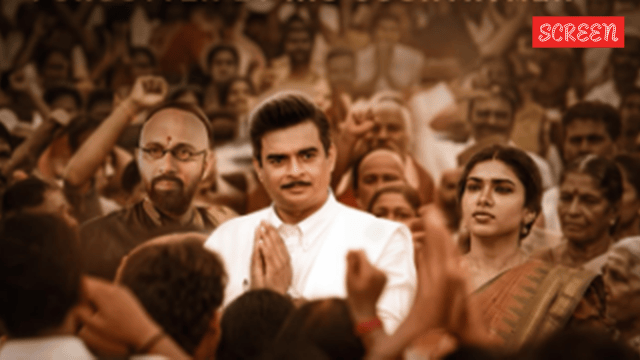
Madhavan, who plays GDN, does full justice to his role. Without fumbling or flinching, he portrays the many shades of the man, both at the professional and personal level. Through Madhavan, we see how GDN contributed not only to science and technology but also to those around him. If his BMW dream had materialised, Tamil Nadu would have witnessed an economic transformation.

But when you reach the top, you either stay there or come crashing down. With GDN, it was the latter. Yet, as Madhavan shows with impeccable conviction, a determined and gritty man can never be defeated. Failures are but stepping stones to more success, and that true success comes to those who refuse to give up.

GDN’s rise coincided with that of the nationalist movement. While the Mahatma and other freedom fighters fought the British politically, GDN fought his through industrial vision and enterprise. He may have ultimately lost to the machinery of British rule, but he never surrendered his dignity or stature.

And that, perhaps, is the film’s most enduring meesage: success is not always about winning the battle. Sometimes, it is about refusing to let defeat diminish who you are.

‘Dhadak 2’ Review: A Bold, Unflinching Look at Caste 

Dhadak 2 is Shazia Iqbal’s Hindi adaptation of Mari Selvaraj’s Tamil film ‘Pariyerum Perumal’. It portrays an inter-caste couple’s fight against caste prejudice. 

Neelesh (Siddhant Chaturvedi), a Dalit student of law, has a simple and straightforward goal: to study hard, become a lawyer, and lift his family out of poverty. He avoids political activism, lest it derail his long term plans. He finds an empathetic friend in Vidhi (Tripti Dimri), who helps him understand the subject. And, like what happenes in most college friendships, theirs deepens into love.

Neelesh’s subservience and timidity get him nowhere: he is constantly reminded of his place in the caste hierarchy, whether in college or at social gatherings. Neither can he claim his right as a student, nor can he escape casteist taunts. 

His struggle is reminiscent of real-life Dalit students who paid the price for speaking out. The case of Senthil, the Dalit student in the University of Hyderabad who took his own life, comes to mind instantly. And when Shekhar (Priyank Tiwari), Neelesh’s contemporary in college and a fellow Dalit, resorts to the extreme step after being suspended for protesting, one cannot miss the resemblance with Rohit Vemula.

When his face is disfigured by upper caste students in college, the lion in Neelesh awakens. Siddhanth Chaturvedi plays Neelesh’s transformation into a confident and assertive individual, who will not take injustice lying down, convincingly.

Like Siddhant Chaturvedi, Tripti Dimri does full justice to her role. She is not the hero’s usual sidekick and carves out an identity and place of her own. Bold and outspoken, she doesn’t hesitate to ask uncomfortable questions, even if that means challenging her family’s honour. 

Full marks to Shazia Iqbal for boldly engaging with a sensitive theme like caste. She highlights the humiliation Dalit students face in our universities, capturing the stigma in all its rawness. She also addresses the problematic issue of upper caste family honour with the same brutal honesty.

Dhadak 2 is powerful in its treatment of caste. The crisp narrative, sharp dialogues, and engaging story enhance its appeal. It is a must-watch that doesn’t just entertain but compels reflection. The quote at the beginning of the movie sums it up best:

“When injustice becomes law, resistance becomes duty”