Halal Love Story : A Film That Keeps The Faith In Humanity

”Halal Love Story” is a movie about a group of Muslim men who want to make a telefilm to spread the teachings of their Islamic organisation. It captures the constant tension between halal (permissible) and haram (forbidden) and the Muslim community’s struggle with liberal values like democracy and equality. 

There are two movies being played out. One is the main movie and the other is the movie within the main movie that the characters (of the main movie) are attempting to make. 

A genuine creative process is not bound by any limits or rules. It does not fear religious or traditional repercussions. But the movie within Halal Love Story is bound by a halal script. For instance, the lead pair cannot be strangers; the script demands they know each other. It thus follows that the deeply religious Shareef (Indrajith Sukumaran) and his wife Suhara (Grace Antony) are cast in the lead role. The scenes between the two are laced with humour and make for an entertaining watch. The couple also shares some tense moments when Shareef resents Suhara’s superior acting skills, thereby affecting their on-screen chemistry. However, the two make up after Taufeeq (Sharafudheen), who is in charge of the film making, brokers a truce.

Grace Antony is easily the star of the movie, both within and without. She shines as Suhara, the subdued homemaker who blossoms as a fine actor on the sets. Indrajith Sukumaran’s performance as the well-mannered Shareef, who is forced to come to terms with his limitations, deserves applause too.

Other scenes explore the ambiguous definition of Halal and Haram. Raheem (Nazer Karutheni), the leading light of the local branch of the Jamiathu Ikhwan Al-Wathan organization, recruits screenwriter Taufeeq to pen the script. But the duo realises that a perfectly halal director is a rare commodity. They hence settle for Siraj (Joju George) , a non-believer who smokes and drinks. Like Shareef and Suhara, Siraj finds it difficult to keep his messy personal life out of the movie but eventually makes peace. 

Soubin Shahir does a cameo as a sound recordist and is responsible for most of the comedy. He shuts down an entire village, disallowing housewives from washing clothes and forcing people to freeze mid-step when he shouts ‘Silence’ for a perfect take.

Director Zakariya Mohammed has explored a bold theme in Halal Love Story. Firstly, narrating two movies, one within the other, needs skill and acumen. In addition to that, he has made a strong case for a middle ground between tradition and modernity. In the process, he has just tickled the ribs of, without laughing at, the scriptures. I would also prefix the movie with the term ”feel-good” because there are no losers. Everyone, despite their personal issues and ideological biases, evolves and grows in the process of shooting.

Halal Love Story’s storyline was a little too simple, just like the men who embark on making the movie within the movie. But given the challenging theme, it is possible Zakariya did not want to take a risk.

Halal Love Story has a loud and clear message, which is that when tradition and modernity collide, it is humanity that must triumph. 
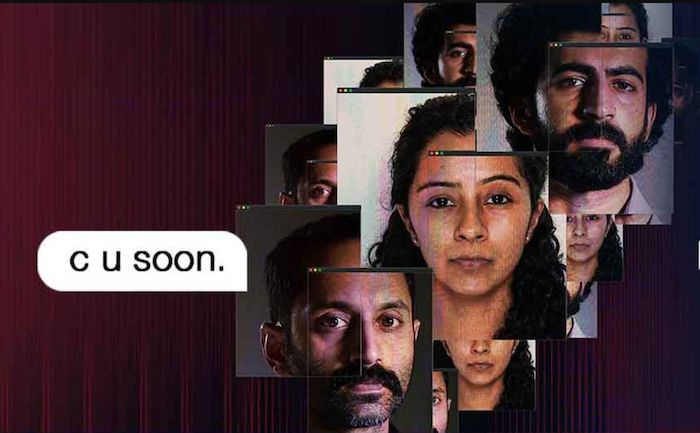
Heart Needs Rebooting As System Crashes : C U Soon Movie Review

“C U Soon” is a movie about Dubai-based Jimmy (Roshan Mathew) who falls in love with Anu (Darshana Rajendran) after they meet on Tinder. Jimmy proposes to Anu on a video call as his family watches from across the world. His worried mother (MaalaParvathi) asks her nephew Kevin (Fahadh Faasil), a cyber sleuth in the US, to verify Anu’s antecedents.

Just when it seems that the couple is ready to take the next step, a twist emerges with Anu’s disappearance from Jimmy’s home. There is more to it than meets the eye, prompting the Sherlock Holmes in Kevin to come alive. His digital-forensic skills are used to the maximum.

The plot thereafter is predictable. However, the movie’s intelligent use of digital communication devices ensures the audience does not stop paying attention. Suspense is a by-product of the innovation.

The screenplay rests entirely on computer screens and mobile devices. The dialogue comprises of text messages or video chats. At any given point, there are two cameras at work – the one of the image capturing device connecting actors at two ends and the other of the master movie camera. Both complement each other without getting in the other’s way. Only editing of a high standard could have achieved that. 

Additionally, C U Soon captures technology’s tremendous scope in searching, finding and deliberating. One is amazed at the speed and efficiency with which Kevin deciphers the truth with his nimble fingers on the keypad. The film’s extensive use of Google searches, Maps, WhatsApp chats and Hang Outs reminds me of what someone once said, namely, that technology has made “knowing” irrelevant. After watching “C U Soon” I could not agree more.

For millennials familiar with mobile jargon, the title ‘C U Soon’ would make perfect sense and the screenplay seem natural. However, even for those not comfortable with dating apps or social media platforms, the movie manages to be engaging. 

Despite its unimaginative plot, I would commend Mahesh Narayanan for attempting such a challenging genre. The movie was made so that a set of film makers could earn money during the lockdown. Remarkably, they have not disappointed and the audience never feels the lack of sets, travel and exotic locales. Far from being a disadvantage, Social Distancing is used creatively. 

Fahad Faasil’s composure and subtle expressions complement Roshan Mathew’s impulsiveness. The latter’s fly-by-night love affairs remind you of the exuberance of youth. Darshana Rajendran deserves applause for a solid performance.

“C U Soon” is truly a movie meant for the lockdown period. In addition to teasing your brain and making you see film-making in a new light, it reminds you that movies offer a glimmer of hope in challenging times. 

“Gunjan Saxena- The Kargil Girl” Review

A4B032A0-C5F9-4964-B8F2-DDFE1A3D6200

Gunjan Saxena – The Kargil Girl, Sharan Sharma’s directorial debut is about India’s first female Air Force pilot in a combat role and the obstacles she faces in a male-dominated world.

There are two wars being fought. One is the Kargil War of 1999 between India and Pakistan. The other is Gunjan Saxena (played by Jahnavi Kapoor)’s personal battle against a world that refuses to believe in women. Whether it is the absence of toilets for female officers, a condescending flight instructor or a discouraging older sibling, Gunjan Saxena’s real battles are not on the front lines.

The movie begins with a nine-year-old Gunjan (Riva Arora) wanting to peep out of an aeroplane window, but not being allowed to by her older brother (Aryan Arora). When a young Gunjan says “Mujhe Pilot Banna Hai”, her brother sarcastically remarks “Mujhe Kapil Dev banna hai”.  Clearly, there is no dearth of negativity in Gunjan Saxena’s life. However, she pursues her dream with hard work and determination.

The turning point in the movie is the belan (rolling pin) scene between Gunjan and her father Lt Colonel Anup Saxena (Pankaj Tripathi). The father reignites in daughter the will to carry on chasing her dream when Gunjan is on the verge of giving up.

Gunjan Saxena’s father Anup Saxena is her bedrock of support throughout in a quiet and unassuming way. He is the hero in her life without whom she could not have scaled such heights, literally and figuratively.

When the older Gunjan asks her father whether joining the IAF because she is passionate about flying and not because of a sense of duty towards her country amounts to treachery, Anup Saxena replies that the armed forces do not need people who shout ‘Bharat Mata Ki Jai’. What they require are passionate personnel who do their work with honesty. This bold differentiation between passion and patriotism in an era when the two are prone to getting mixed up is commendable.

If one were to subtract the war backdrop from the movie, “Gunjan Saxena – The Kargil Girl” would resemble any workplace with its patriarchal biases. The daily struggle of ambitious women to prove their worth and the umpteen hurdles in their way sound eerily familiar.

Pankaj Tripathi says a lot with just his expressions; his brilliant acting skills are on full display despite minimum dialogue.

Gunjan Saxena’s mother (Ayesha Raza Mishra) dissuades her from chasing her dream. Her brother Anshuman (Angad Bedi) means well but sides with his mother. By the end of the movie, the two are forced to change their opinion on women pilots when they see Gunjan excel in her chosen role.

Jahnavi Kapoor does a fairly good job of playing Gunjan Saxena. Her lack of experience shows but is not glaring. Being a newcomer in the film industry, her performance is bound to get better with every movie.

Wing Commander Dileep Singh (Vineet Kumar Singh), Gunjan Saxena’s flight instructor at Udhampur, is condescending towards her. He introduces her to his male cadets as “Miss Badlav” in a tone that is far from complimenting. By the end, he is forced to swallow his pride.

The biopic is compact and neatly packaged. The cinematography is uncluttered. The scripting is not lazy with a clear focus on Gunjan’s struggle in the Air Force. No time is wasted on chest-thumping war scenes either. The Kargil war scenes are short and businesslike thereby retaining the focus on the pilot’s life. Clearly, content takes precedence over sensationalism.

Gunjan Saxena – The Kargil Girl is bound to inspire women who dare to dream big.

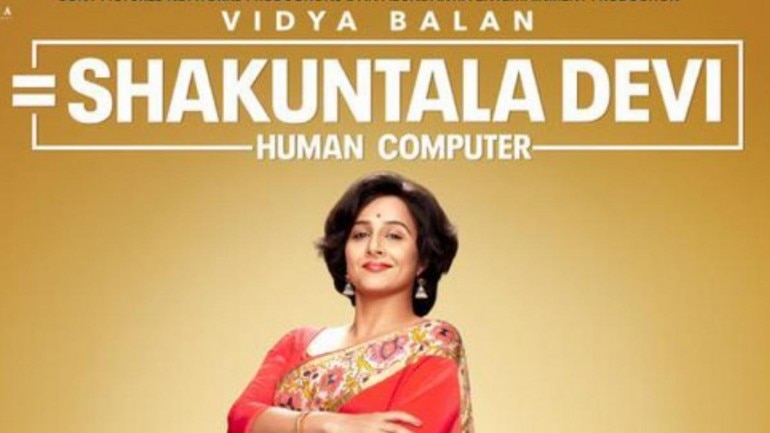
Shakuntala Devi : The Unseen Side Of A Brilliant Mathematician

844ABF71-F06D-4236-8CA8-E21AEC1346B0

Shakuntala Devi – The Unseen Side Of A Brilliant Mathematician (Review)

As the name suggests, Shakuntala Devi (played by Vidya Balan) is a movie about the math genius from Karnataka who enthralled the world with her numerical abilities. The film also explores Shakuntala Devi’s turbulent relationship with her daughter, father, mother and husband. 

Shakuntala Devi the movie traces the mathematician’s life and her transformation from a child in a poor Karnataka family to a superstar in the world of mathematics. Her abilities put her on par with the best and the brightest. 

Loud, bold and ambitious, Shakuntala Devi is like an untamed horse let loose on the racing track. She is a non-conformist who dares to enter and dominate the world of mathematics, traditionally a male bastion. She revels in the adulation she receives and is intoxicated by success. Her relationships with men enamoured by her brilliance defy social norms.  This is apparent when she advises her daughter Anupama Banerjee to find another partner as living with the same man can get boring.

Vidya Balan is a seasoned actress who does a brilliant job of playing Shakuntala Devi. She portrays how the mathematician lived life on her own terms despite the pulls and pressures of society. Her experience in Dirty Picture and Mission Mangal seemed to have served her well. She is the embodiment of a feminist dream-turned- nightmare as she resolves to fight gender inequality both at home and outside. This burning desire comes not surprisingly from her own lived experiences where she was pulled out of school, denied a normal childhood and used as a golden goose by her father.

Ironically, in trying not to repeat the mistakes of her parents, she goes overboard enveloping her daughter Anupama in a suffocating embrace. This makes Anupama resentful and leaves her longing for the freedom to be herself. Sanya Malhotra’s portrayal of Anupama is a brilliant performance by a rising star. When she announces in scene one that she is contemplating legal action against her mother, the audience has no choice but to remain glued to the screen for the remainder of the movie. Malhotra succeeds in playing Anupama who, quite unlike Shakuntala Devi, hates maths and abhors any comparison with her mother.

Director Anu Menon has tried to portray the black, white and grey of every character in Shakuntala Devi. To her credit, she is careful not to glorify or demonise anyone. Each character is shown playing their part as actors on a stage would. In fact, Vidya Balan refers to this Shakesperean quote in the course of the movie.

Shakuntala Devi’s personal life is not as precise as her number-crunching abilities. She is shown excelling as a mathematician but ”failing” in every other sphere. This inability to reconcile the personal with the professional is true of most successful people. However, while men have models they can emulate, women do not. The women thus end up paying a bigger price for success than men. Quite understandably, women’s personal lives are often at odds with their professional one’s. The movie proves that successful women do not inspire awe; they only end up looking like poor caricatures of their male versions.

Jishu Sengupta, who plays Shakuntala Devi’s husband Paritosh Banerjee and Amit Sadh, who plays Anupama’s partner are portrayed as gentle, caring and supportive husbands. Possibly the Director Anu Menon, who was obviously in awe of Shakuntala Devi did not want to waste footage on the men.

The ending is a bit contrived because Anupama comes to terms with her turbulent relationship with her mother when Shakuntala Devi abruptly reverses her decision to deny Anupama her share of the property. Love is seen sinking the duo’s differences.

Shakuntala Devi is a movie that has done justice to the mathematician’s life. It is a revelation for anyone who is unaware of her darker side and her tough childhood.

How The Covid 19 Lockdown Helped Me Quit Smoking

imagesI have been a smoker for the past fourteen years. I remember the day when I was offered a cigarette by a friend over a cup of tea in a Hyderabad restaurant. It was the end of a tiring day and my first puff seemed divine. It was relaxing, liberating and provided me with a release from a stressful and challenging work environment.

I was working as a journalist in TV9 in Hyderabad. It is an open secret that journalists are overworked, especially those in electronic media. And having attained seniority in the digital marketing team, I was expected to give more than one hundred per cent. This meant that I had to be sharp, quick and achieve targets on time. This added to my stress levels. I also realised why journalists are often seen guzzling alcohol at the press club. And why many of them die prematurely.

As smoking became a daily habit, many of my friends and colleagues ( who were shocked because I hardly seemed the kind who would go astray) tried to talk me into giving it up. They counselled me about the health risks associated with the deadly habit, but to no avail. I did my level best to kick the habit but would be back to square one each time. I badly wanted to quit too because, in addition to the health risks, I was beginning to face stigma from friends and family alike. I recall one of my colleagues saying ”Yeh Kanishka tho phaltu go gaya”, which in English means ”Kanishka has turned out to be a good for nothing oaf”. Such comments dented my self-esteem and confidence but did nothing to help me quit. Besides, I was not doing well professionally and was using cigarettes to vent my frustration. I was caught in a vicious cycle.

As the years rolled on, my name became synonymous with smoking, especially at work. If someone referred to me, they would say ”Oh yes, I know Kanishka. He’s the one who smokes like a chimney, right?” I was but a mere shadow of my former self, both physically and emotionally. I knew deep down that it was important to quit, but hadn’t the faintest idea of how to go about it.

As I have mentioned before, my professional life was not going well either. Fortunately, problems on the work front sorted themselves out in a little while. But I remained a smoker. I think the main reason I was not able to quit smoking, even though I was doing well at work, was the stress. Long working hours coupled with the pressure to perform made me turn to smoking for release.

I made a major career move in 2018. I bid goodbye to my TV9 job and shifted to Bangalore to work at the Rangoli Metro Art Center. I then managed to cut down my smoking to five cigarettes a day. On a visit to Hyderabad once, (in Nov 2019 I think ), I met my former colleague, the one who had made the ”Phaltu” comment. He asked me if I still smoked, to which I replied yes and added that kicking the habit seemed like a daunting task. He advised me to keep trying and not give up.

A few days into the lockdown, cigarettes were in short supply. On the advice of my mother, I began breaking whatever cigarettes I had left into two and smoking just one half, instead of the usual full cigarette, every time. I then realised that if I could bring down my smoking to three cigarettes a day, then quitting for good should not be difficult. And lo and behold, as I write this, it has been eight days since I smoked! And I am also able to resist the temptation whenever I see a shop that is open and selling cigarettes.

I am now able to smell and taste things better. I am able to meet people confidently without worrying about smelling bad. My appetite is back to normal and I am sleeping well. I haven’t felt so good in a long while. Yes, there is always a risk of a relapse once the lockdown ends, but I am confident that with a bit of will power I will stay on course.

I think more than the actual work-related stress, it is the maladaptive ways of dealing with the stress that is a cause for concern. Habits like smoking and drinking are easy, albeit dangerous, ways of coping. And once you get used to unwinding over a drink or a smoke, it becomes difficult to break out of the cycle.

I am glad that I have finally managed to quit smoking and am back on the track to good health. If anyone of you have similar issues, please remember that quitting smoking, alcohol or drugs is possible. It is certainly not easy, but with professional and family support, the battle can be won.

Thappad : Domestic Violence Unplugged

IMG_0076Thappad is a movie about Amrita (played by Tapsee Pannu) who fights her husband Vikram (played by Pavail Gulati) for treating her like a doormat. It revolves around the humiliating slap that Amrita receives from Vikram and through the story, the film addresses the normalisation of domestic violence in Indian society.

Vikram and Amrita are a happily married couple in Delhi. He is the breadwinner of the family while she chooses to be a homemaker. Amrita supports Vikram to the hilt, doing all the housework and taking care of her ageing mother in law (played by Tanvi Azmi). Amrita is easily Vikram’s bedrock of support without whom he could not have realised his dreams. But things turn sour when Vikram slaps Amrita at a party that the couple hosts to celebrate his promotion to London, a celebration that loses its sheen when Vikram is told he is the number two, not the number one, in the London office.

Thappad takes on the issue of domestic violence head-on and exposes the double standards of Indian society over the issue. When a shocked Amrita seeks justice, her mother-in-law is shown worrying about Vikram’s health instead. In another scene, a frustrated Vikram tells Amrita that he has taken enough from his boss and it is time he puts his foot down. The irony of the situation dawns on us because she has been treated like a doormat and hence should enjoy the luxury of complaining, just like Vikram.

Pavail Gulati plays the smug and mechanical Vikram with elan. He selfishly believes that he is the only one suffering while others have it easy. He has not a shade of concern for Amrita, constantly wallowing in self-pity and expecting the women around him to sympathise. He succeeds in making you want to hate the spoilt brat that is Vikram.

As mentioned earlier, Thappad is a commentary on the normalisation of domestic violence in Indian society. For instance, when a shocked Amrita seeks comfort in her parents’ company, her mother (played by Ratna Pathak Shah) advises her to not make a mountain out of a molehill and sort things out instead. Men, after all, have their share of frustrations and need to be understood in this light. But what about Amrita’s feelings? Doesn’t she have a right to be treated with dignity? The film also rightly blames Indian mothers for cloistering their daughters. Again, Thappad highlights how mothers teach their daughters to treat their parents as parayas, or strangers. They are told that they really belong to their in-laws. The lack of choice for girls in conservative India comes through forcefully.

Amrita’s father Jayant (played by Kumud Mishra) is her source of support in a quiet and unassuming way.

Thappad is a commentary on the lives of the other women too, such as Amrita’s lawyer Nethra Jaisingh (played by Maya Sarao) who initially urges her client to patch up with her husband but ultimately realises that her own partner has been patronising and denying her the credit she deserves. She eventually walks out of her marriage.
Amrita’s maidservant Sunita is also shown caught between tolerating her abusive husband (according to society’s norms) and desiring freedom and dignity.

With Thappad, Tapsee has proved her mettle as an actor. The scope for etching out Amrita’s character was immense and actress has risen to the occasion. Her subtle expressions, when she bids adieu to Vikram’s mother toward the end, are praiseworthy. She blends her happiness over her newfound freedom with the pain that invariably comes from separation. One notices her grow from the innocent housewife Amrita, who has tolerated ambivalence from her husband’s family for far too long, to a more assertive individual aware of her rights.

Dia Mirza deserves applause for playing the widow and single mother Shivani James Fonseca. She is Amrita’s pillar of strength throughout and displays both grace and maturity.

Thappad, while attacking the family system also does not spare the legal system. It shows how battered women are encouraged to patch up with their abusive husbands because a legal battle can be draining, both financially and emotionally. But it also shows that if a woman has the stomach for a fight, she is unstoppable. Amrita ends up winning both her divorce case and the custody of her unborn child, without compromising on her principles. She is not tempted by Vikram’s offer of a share in his property in return for the child’s custody. Though shocked by Vikram’s nonchalance, she stays simple and straightforward.

Thappad sends out a loud and clear message – wife-beating is unacceptable, even if it is not habitual.

SUPER 30 REVIEW

Super 30              s2

Vikas Bahl’s Super 30 is based on the life of brilliant mathematician Anand Kumar who helps thirty smart but underprivileged children prepare for entrance exams to the IITs. The film showcases how poor students with meager resources struggle but eventually triumph with guidance from Kumar.

Hrithik Roshan, who plays Anand Kumar does justice to his character. Having got used to seeing him in romantic or superhero roles, it must have been challenging to play a mathematics teacher. The audience would naturally find it difficult to relate to him. However, one can spot the effort that he has put into fleshing out Anand Kumar’s role. Take for instance the way he magnanimously responds to the humiliation meted out to him by the librarian of a reputed college. Another instance is when Kumar manages to get into Cambridge but is short of money to realize that aspiration. He sees his father die trying to raise money for the purpose. This scene is a sad commentary on how intelligent youth from poor backgrounds lose opportunities merely because of their economic status.

Super 30 successfully engages with the question of privilege and class bias in other ways too. For example, Kumar is seen motivating his students who are weak in English to stand up to their counterparts from English-medium schools. The scene where they do a skit in English with privileged kids as an audience is praiseworthy. The skit, an idea conceived by Kumar teaches his students to believe in themselves and never give up. In many other scenes too Kumar is seen emphasizing the importance of education to his students.

Anand Kumar is regarded as a precious teacher by his students, and he is in great demand from the rich and poor alike. But while batting for the rights of the poor, Vikas Bahl’s Super 30 does not succumb to the temptation of painting privileged children as villains. For example, there is a scene where a rich former student of Kumar asks him why he is depriving them of his teaching. Is it because he is privileged? The irony of the situation is stark.

Another notable scene in Super 30 is when the local MLA Shriram Singh (played by Pankaj Tripathi) breaks his promise of helping Anand Kumar. Hrithik portrays Kumar’s disappointment with ease and confidence. Full marks to Pankaj Tripathi for making us cringe at his crookedness and pettiness, either in the pipe dreams he sells to Anand Kumar and the rural folk or in his involvement with the coaching mafia. He truly makes you want to hate him.

Super 30 has its share of comedy too, such as when Hrithik enlightens his first love Supriya (played by Mrunal Thakur) on the mathematical ratio used to measure beauty. I never knew that such a ratio existed and was pleasantly surprised to learn of the same. The movie thus weds Anand Kumar’s obsession with mathematics with his love for Supriya.

Mrunal Thakur depicts Supriya, a girl from an elite background who doesn’t carry that status on her sleeve. After all, she is the daughter of a rich businessman but is dating the son of a postman. She is neither too brash nor too simple but subtly gels into her character. One loves her in the second half when she steals an important document to rescue Anand Kumar’s dream. She is a delight to watch when she tells her IAS officer husband (who is aware of her past with Kumar) that her choice of men has always been sound! For a newcomer it is a great start.

Personally, I sympathized with Lallan Singh’s character (played by Aditya Srivastav) for being let down by Anand Kumar. His position is unenviable and hence credit is due to Srivastava for portraying the money hungry head of a successful coaching centre who is eventually defeated by Anand Kumar.

Anand Kumar’s innovative teaching techniques are at the fore in Super 30. The maths, physics and chemistry concepts are explained well and used intelligently in the fight sequences which are worth watching purely for this reason. They mask any kind of boredom that might arise owing to their length.

Anand Kumar’s fight against a corrupt system and his obsessive need to help needy students reminds one of Robin Hood. He is willing to risk his life for the sake of educating his students. The second half is replete with scenes of violence when Anand Kumar’s rivals gun for his blood.

The larger point that Super 30 makes, which is that students from poor backgrounds have it in them to be successful, provided they are smart and determined, is not lost on the audience. This forms the heart and soul of the movie and is as precise as one of Anand Kumar’s maths lectures. The movie’s heart literally beats to the tune of justice for the underprivileged.

Super 30 is a bold take on India’s education system that is corrupted by nepotism and privilege. Considering that it is based on a true story makes it all the more relevant.


The Axe “After” Effect

Advertising and marketing are the driving forces behind a brand’s success and are therefore cautious about societal attitudes. It has been noticed that when there is a shift in the worldview of the consumer, advertisements adjust accordingly. For example, Complan, a milk-based energy drink for children, initially showed only boys benefitting from it and saying “I am a Complan boy”! Very soon, they changed to also showing girls saying “I am a Complan girl”. This was appreciated by women’s groups who wanted better representation of women in the media. This happened in the 90s in India when Complan  was a rage with the masses. This is also true with Gillete that changed its tagline from “The Best A Man Can Get” to “The Best Men Can Be”. (Refer https://interestincinema.movie.blog/2019/01/24/the-gillete-ad-controversy-analysed/).

But this curious and bizarre evolution of commercials is most striking in Axe body spray ads. In the early years, Axe appealed to masculinity. Many of them were steamy and encouraged men to use their sprays. By that time, grooming and body care were no longer the exclusive domain of women, and men wanted to increase their desirability quotient.  Axe ads showed men getting lucky with women merely because they sprayed themselves with their deodorants. It was called “The Axe Effect”.  Right through the eighties, nineties and the 2000s, Axe ads appealed to this hidden desire of lonely men – of wanting to get popular and make out with women. Axe promoted masculinity aggressively and was naturally a hit. It became popular with women too as they wanted their sons, brothers and husbands to be more masculine.

Masculinity has seen a resurgence with the rise of Trump. However, at the same time many men are questioning Trump’s push towards aggressive masculinity and desire a gentler and more humane version of machismo instead. These are the men who struggle with their softer sides, sensitivity, bullying, sexual orientation or depression. In fact, many are turning to the internet for answers to questions like “Is it ok to be a virgin”, “Is it ok to experiment with guys”, and so on.

It was in 2016 that Axe came out with a new advertisement Is It OK for Guys? that broke macho stereotypes. It was a part of its “Find Your Magic” campaign. It urged men to not be ashamed of crying, being a virgin, belonging to an unconventional sexual orientation, being emotional, disliking sports or wearing make-up. The commercial shows men Googling answers to these questions. Remember, this was the same company that once relished running ads portraying women as sex-starved and encouraged lonely men to douse themselves in Axe body spray so that the ladies came running.

Axe insists it has changed for the good. It claims that it is even supporting groups that counsel sensitive men. It is leading the campaign to change the narrative around masculinity. The commercial appears to be heralding a new era in the field of advertisements. While critics may argue that this complete U-turn by Axe is aimed primarily at profits, the fact remains that in the process, it is recognizing the growing number of men who are embarrassed by their sexual orientation, sensitive nature or lack of exposure to sex. While it might be unrealistic to expect a dramatic change in the mindsets of people about masculinity, Axe’s new advertisement is certainly a step in the right direction. More significantly, it proves how the advertisement world is in sync with a constantly changing and evolving society.

The Uri Effect, Post Pulwama

Uri, the movie about India’s surgical strikes on terror launch pads in Pakistan Occupied Kashmir resonates with (or maybe even determines) the present mood in India, post Pulwama. The movie somehow demands that everyone participate in experiencing a “Josh” or acting out on it (by beating up Kashmiris, threatening Muslims who are deemed anti-national by default). The protagonist Major Vihan Singh Shergill, played by Vicky Kaushal is an ace military strategist who is forced to return to home to care for his mother, an Alzheimers patient. During this time he loses his brother-in-law, Major Karan Kashyap (played by Mohit Raina) in the Uri attack. Thirsty for revenge, he begs his commander to let him return to the frontlines for the greater good of the motherland.
In the first half of the movie, Major Vihan plays the role of a responsible son, loving uncle and friendly brother, all at once. The camaraderie he shares with Major Karan is typical of the armed forces, but there is nothing more that endears you to him as an actor. His performance is clichéd, lacking depth or nuance. After seeing him in Sanju, one feels he has not done justice to his talent. But the war hysteria and passionate anti-Pakistan slogans are used effectively to mask the otherwise dull performances.
The second half of the movie revolves largely around the planning and execution of the surgical strikes. The discovery by Ajit Doval (played by Paresh Rawal) of a bird-shaped drone invented by a DRDO intern is the only thing that adds a spark to the movie. Unfortunately, it is not developed enough.
The manner in which the scenes are stitched up leaves a lot to be desired. Even the war scenes are just deafening gun fire and as expected, the Pakistanis are shown as no match for the Indians.
By this time Major Vihan’s family – his mother, widowed sister and niece –seem to be erased from the audience’s memory. If the movie aims to prove that the call for revenge supersedes all other responsibilities, it fails to do so again. And it is this attitude that is on display in the India of today. Unfortunately, one (fictitious) man’s call for revenge has become a personal call to the youth of the country. People have taken it upon themselves to teach Kashmiri students a lesson after the terror attack in Pulwama, despite no evidence of their involvement. Innocent Kashmiris across the country face persecution for deeds they are not guilty of.
There are other problems with the movie too. For instance, the euphoria of revenge for the Uri martyrs drowns the audience’s capacity to think critically, leaving no scope for reflection. Doesn’t one wonder why war widows dressed in white (in this case Vicky Kaushal’s sister) are left in the lurch as their husbands are on the frontlines, and only see their partners in coffins? Families of military personnel always struggle with their absence. And when soldiers die, they leave behind widows and orphaned children. Nowhere in the movie are these dilemmas addressed. Instead, war in all its madness is glorified. True, the movie is essentially about war and the sacrifices that our soldiers make. But is it not possible to shine a torch on the senselessness and madness of war too?
According to “Uri-The Surgical Strikes”, the ends justify the means. The audience is encouraged to sympathize with Major Vihan Singh Shergill’s character and some even echo ‘How’s The Josh’ on the other side of the screen. Moreover, this echo also drowns any serious critique about issues that have recently come to light (bad food for our soldiers, no leave, poor treatment of jawans, harsh weather conditions etc).
“Uri-The Surgical Strikes” leaves nothing to one’s imagination. It does little more than glorify the armed forces and whip up war hysteria. Of course, the endless scenes of violence and gore fill the audience with ‘Josh’. However, what is missing is a calm and reflective assessment on the failures of the Indian state that may have alienated Kashmiris and minorities Where is the attempt to win the hearts of young Kashmiris? The Kashmir Question is a very complicated one and needs to be dealt with at various levels, beginning with dialogue, dialogue and dialogue!images

WHEN PSEUDOSCIENCE GOT THE BETTER OF SCIENCE

“Einstein and Newton misled the world with their theories”. “Ancient India had perfected stem cell technology and had developed guided missiles”. “The Kauravas were test tube babies”.

These sentences haven’t been lifted out of a novel or a fantasy movie. They were stated by the Vice Chancellor of Andhra University, G Nageshwara Rao and Dr.Kannan Krishnan, a research scientist at the Indian Science Congress in Jalandhar.

The scientific community in India and abroad naturally reacted with shock, for the basic reason that stem cell technology, invitro fertilization and plastic surgery are recent advances and have emerged after years of research and experimentation. It’s very simple. For any technology to be called scientific, it must possess the capacity to be reproduced by anyone anywhere. Did that happen? The answer is no. It is very worrying that Indian academics are making claims by misreading religious texts, and not on the basis of hard facts and evidence.

In fact it was Prime Minister Modi who set the trend of outlandish claims back at the Indian Science Congress in 2014. He said that since Lord Ganesha had the head of an elephant and the body of a human, ancient India was well-versed in plastic surgery. Another minister claimed that since the Ramayana spoke of Ravana’s Pushpak Viman, India of those times had planes, complete with functional airports. This is a familiar strategy by Hindu nationalists of the ruling Bharatiya Janata Party to invent the greatness of India’s past. They smack of religious nationalism and an attempt to whip up a sense of Hindu religious pride, to undermine the truth for their narrow political ends, not quite unlike the Nazis did in Germany in the early 1920s.

But why are scientists and academics at the Indian Science Congress giving into this false rhetoric? It is clearly to please their political masters and land plum postings. I see similarities with what the Telugu poet C.Narayana Reddy did by introducing astrology in AP textbooks to get into the good books of the then AP Chief Minister NT Rama Rao, himself an astrology enthusiast. What resulted was an entire generation of students fed on pseudoscience.

There is no reason for Indians to resort to fake, unsubstantiated claims to have pride in their history. India has a very strong place in global scientific history, as the birthplace for key mathematical ideas, metallurgical technologies and home to the sophisticated Indus Valley Civilisation, which had weights and measures. Indeed, our country has produced geniuses like Ramanajun and Bose. What the ISC is doing is to make our country a laughing stock in the eyes of the world.

India’s is the only constitution in the world that urges its people to develop a scientific temper. Sadly, the ISC is doing little to achieve this. At the Jalandhar meet, the students should have been allowed to mingle freely with scientists and exchange ideas. Many students could very well have been inspired to take up science as a profession.

Silly stories per se are not of concern. What is worrying is when important people say dumb things, especially those manning major universities. Instead of instilling a spirit of enquiry in students, our academics are doing just the opposite. And it is sad that urban, educated, working professionals fall for such cock and bull stories. A major catalyst for this is Whats App. Even those who cannot separate chalk from cheese believe they are experts on the basis of Whats App forwards.

Amid the uproar, the Indian Science Congress has clarified that it does not subscribe to the worldview of a few scientists who made the mundane claims. This hopefully means that the prestigious science event is on its way to regaining its lost glory. The time has come to throw pseudoscience out of the window. I am tempted to quote from the motto of the Royal Society which reads “Nullius in verba” , latin for “Take Nobody’s word for it”. The ISC is in urgent need to imbibe this slogan.