Review of The Hunt – The Rajiv Gandhi Assassination Case

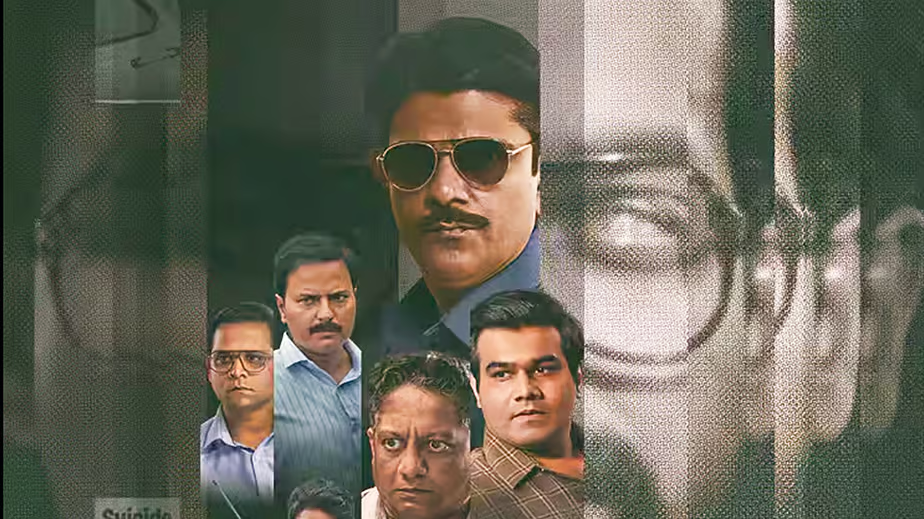
‘The Hunt – The Rajiv Gandhi Assassination Case’, is an OTT series about the probe into the assassination of former Prime Minister Rajiv Gandhi in Sriperambdur in 1991. As the country comes to terms with the brutal murder, a Special Investigation Team (SIT), set up to nab the culprits, swings into action.

Establishing the LTTE’s role in the assassination is not difficult. The real challenge lies in nabbing Shivarasan, the mastermind of the plot. Amit Sial plays D.R. Karthikeyan, the lead investigator. In the words of his superior, Karthikeyan’s is the toughest job in the world. He faces pressure from all quarters – politicians, pro-LTTE Tamils, and a restless team. Yet, with a restrained demeanour, Sial impresses as the stoic Karthikeyan who rises to the challenge and keeps his team united & focussed on the ultimate aim. He is the fire that keeps the team’s spirit burning and the officer who leads by example. 

While showcasing the brilliance of the SIT, The Hunt says a lot about the support that the LTTE enjoys in Tamil Nadu. According to Inspector Ragothaman, the only Tamil officer in the SIT, “One man’s terrorist is another man’s freedom fighter.” A small sentence that speaks volumes.

Director Nagesh Kukunoor manages to evoke drama, intrigue, and suspense. Every scene captures the tension of the investigation, making you want more. The sharp editing and concise script also do their bit to engage you. I also laud Kukunoor for ending the series on an unresolved note. Yes, the SIT nabs Shivarasan and his team of LTTE operatives, but, as officer Amit Verma puts it, with Shivarasan’s death, the truth is also buried. The audience grapples with more questions than answers, a lot like life…..
FIRST IMPRESSIONS OF KARWAR

After our whirlwind marriage in Hyderabad, Swapna and I were brimming with excitement for our upcoming honeymoon in Karwar. We were eagerly looking forward to the trip, hoping it would provide a much-needed respite after the hectic weeks leading up to our wedding.

As planned, we took a bus to Karwar on Tuesday, October 8. After a bumpy ride, we disembarked at the Karwar municipality the following day. We hired an autorickshaw and landed at Sterling. The staff applied tilak on our foreheads to welcome us. They knew we were newly married. 

The room was cosy, just perfect for the two of us. After a refreshing shower, we were eager to explore the local cuisine. I had heard so much about Karwar’s delectable fish dishes, and I was excited to try them. When I saw Pomphret on the menu, I knew I had to have it. The fish, marinated with chilli, salt & spices and shallow-fried, was a burst of flavour. With each bite, I could feel my fatigue melting away, replaced by a sense of rejuvenation. 

After lunch and a quick nap, we walked down to the reception. Nisha, a part of the support staff, invited us to a Karaoke event at the bar. Since Swapna and I were free that evening, we accepted the invite. 

Upon entering the bar, Nisha placed the mike in my hands. I didn’t want to play spoilsport, so I agreed to sing. 

It had been a good twenty-five years since I last sang, back in my school days. I certainly didn’t expect my voice to retain its youthful clarity. But as I stood there, singing in harmony with the lyrics on the screen, I felt a surge of inspiration. The singer in me had been reawakened.

After ending the day on a melodic note, Swapna and I had dinner. We then retired to the room, keenly anticipating our visit to the beach early next morning. The thought of the sun rising over the horizon, the sound of the waves crashing against the shore, and the feel of the sand between our toes filled us with excitement.

VISIT TO BELUR, HALEBID, AND SHRAVANABELAGOLA

Last weekend, I was on a sightseeing tour of Beluru, Halebeedu, and Shravanabelagola. Located in the Hassan district of Karnataka, these towns rose to prominence during the reign of the Hoysala Emperors in the early part of the first millennium and are witness to a slice of medieval Indian history.

We began the tour with a visit to Beluru, a town famous for the Chennakesava Temple (Chenna means Handsome & Kesava is an avatar of Lord Vishnu). The temple was commissioned by the Hoysala King Vishnuvardhana as a tribute to Lord Vishnu in 1117 CE. It took one hundred years to construct and use three generations of workers.

The Chennakesava Temple combines fine architecture, exquisite sculpture, and detailed relief work. Its walls are replete with stories from the Mahabharata, Ramayana, and Puranas. Despite many attacks by Alauddin Khilji’s army, the temple has retained its splendour and is a living embodiment of resilience. 

Dedicated to Lord Shiva, the Hoysaleshwara twin temple at Halebeedu was also built by King Vishnuvardhana and houses the Hoysaleswara and Santaleswara Shiva Lingas. Like its counterpart in Beluru, it is notable for sculptures, intricate reliefs, detailed friezes, iconography, and inscriptions in North Indian and South Indian scripts.

What the two temples have in exquisiteness, the 58-foot Gomateshwara statue in Shravanabelagola makes up for in size. Dedicated to Baahubali, the son of a Jain Thirthankara, the structure is the world’s largest monolithic statue and one of the most important pilgrimage destinations in Jainism.

Thankfully, the weather in Hassan was pleasant. The day we landed, the clouds were on the verge of a cloudburst. Luckily, it did not rain, and as a result, the weather was perfect – neither too warm nor cold. This allowed me to soak in the beauty of Belur, Halebeedu, & Shravanabelagola and appreciate the nuances of their rich history.

Featured

Why I liked Jaane Jaan

Set in the hilly tracts of Kalimpong, ‘Jaane Jaan’ is a movie about Maya D’Souza (Kareena Kapoor Khan), a single mother. When she is accused of murder, she finds unanticipated help from her neighbour, the socially inept but gifted Mathematics teacher Naren Vyas (Jaideep Ahlawat).S

Kareena Kapoor Khan, a seasoned actor, delivers a brilliant performance in a new role. She deftly plays Maya, the cafe owner struggling to make ends meet. While we are used to seeing her exude oomph, in Jaane Jaan, she manages to impress in a middle-aged avatar. Her grace wins her many admirers, most notably Naren. As a result, Naren visits Maya’s cafe often, more for her and less for the egg-fried rice.

Jaideep Ahlawat is terrific as the steely Naren Vyas. Lonely and depressed, he masks his unhappiness with dignity. He cannot articulate his fondness for Maya, whom he loves most after mathematics.

Vijay Varma shines as Inspector Karan Anand, the Mumbai police officer tasked with finding corrupt cop Ajit Mhatre’s killer. He is sharp and trained to look beyond the obvious. However, he is no match for the genius of Naren.  

Varma’s performance is noteworthy because he, being a newcomer to Bollywood, takes on Kareena Kapoor Khan, one of the industry’s most accomplished actors, with confidence. Also, while Karan is attracted to Maya, the movie doesn’t succumb to the temptation of melodramatising the two.

Jaane Jaan is also a story of the triumph of the human spirit against all odds. Naren and Maya, both waging a battle on their personal fronts, show the determination and courage to craft their destinies. While Maya is moving on after a messy marriage, the suicidal Naren finds in Maya a reason to live. Their never-say-die spirit is the thread that holds the story together.

Jaane Jaan is also noteworthy for its crisp narrative. There are no wasted scenes or unnecessary dialogues, and the makers brilliantly pull off a story around a murder cover-up.

What is also unique about Jaane Jaan is how it uses Mathematics to enrich the narrative. Right from Naren’s empathy for a struggling student, Naren’s tireless efforts to solve complex mathematics problems, and the clever use of the subject to obfuscate the truth, the power of mathematics is on full display.

The investigation into Ajit Mhatre’s murder hits a dead end. While Maya is let off due to a lack of evidence, Naren finds the right environment to pursue his passion for mathematics – jail.

Breakfast at Malleswaram

My Sunday began with breakfast at Malleswaram’s Krishna Bhavan. Along with friends at Godrej Woodsman Estate, I was in the mood for authentic Kannada food, and Malleswaram, with its vast number of South Indian restaurants, was the ideal choice.  

We had planned to dine at CTR (Central Tiffin Room), but the long queue of customers discouraged us. After deliberation, we zoned in on Krishna Bhavan; it was close and made equally good food.

Krishna Bhavan is one of Bangalore’s oldest restaurants, famous for Dosas roasted in ghee and served with a dash of butter.  

We ordered a plate each to experience Krishna Bhavan’s culinary magic. Once the dosas arrived, accompanied by chutney and sambar, we wasted no time and got into the act of eating. We relished every morsel, and every bite reinforced Krishna Bhavan’s reputation.

After the first dosa, our minds told us it was time to stop, but our hearts felt otherwise. Deciding to listen to our hearts, we shared a plate of Vada, ‘Green Idly’, and Kesari Baath. 

‘Green Idly’ also happens to be a Krishna Bhavan speciality. It consists of small, fried idlis soaked in green leafy vegetable sauce. Quite unlike the soft idlis that South India is famous for, the frying renders it crisp, and the green sauce, quite strangely, reminds you of chilli chicken. 

Although every item we ordered tasted divine, the Kesari Baath stole the show. Keshri Baath is South India’s equivalent to Halwa. It combines the right amount of sweetness & richness and melts in your mouth like butter. A few amongst us decided to pack some; we were sure our families, especially the children, would enjoy it. 

After finishing a satisfying meal at Krishna Bhavan, we returned to the car. Although we had no alternative but to walk to the car, we realised that walking burnt a part of the calories that we had gained from the rich food. It also assuaged our guilt.  

I bid goodbye to my friends at the car and proceeded to my tabla class nearby. As I walked, I was eager for a repeat of the morning’s breakfast sojourn. Our group rarely spends time outside the badminton court, so a Sunday morning breakfast is an excellent opportunity to bond. After all, what is life without friends and food?

The Island of Guypajama

Guypajama is a lush tropical paradise. A large variety of trees thrive on the length and breadth of the island. As you climb out of your boat and step onto the land, the smell of wet earth greets you. Guypajama is like any tropical region – warm by day and wet by night. 

As you walk around the island, you have leeches sucking the blood out of your feet. They are not painful and hard to discover. I spotted five of them clinging onto me once I returned to my room and removed my shoes. Some had sucked so much blood that they had grown to the size of a tennis ball. 

It is common to see snakes on the island. I spotted one the other day; it was about five metres long, had a hood and was hissing. It met the textbook definition of a cobra.

A thick canopy of trees blocks the sunlight. In some parts, thin shafts of light enter through narrow gaps in the foliage. 

Guypajama is a sensory feast. The air smells of damp earth; the sound of birds confirms again that you are in a forest, far removed from the bustling city. As the humid air engulfs you, you desire a bath.

I spotted a group of howler monkeys in the trees. Their hysterical laughter was annoying. I felt like slapping them but could not, for obvious reasons. Their howling increased when a piece of rotten fruit landed on my head. Indeed, their behaviour was far from cordial – I wished I hadn’t encountered them.

An architectural ruin is present in the centre of the island. The Incas who ruled this area centuries ago had built this fort-like structure.

As dusk approaches, you can hear the birds returning to their nests. Busy with hunting for food the whole day, they are on their way back home, looking forward to relaxing with family.

As night approaches, you hear the sound of crickets chirping. The constant buzz they produce reminds you of a lawnmower and also that it is time to call it a day.