‘Darlings’ Review

‘Darlings’, Jasmeet K Reen’s directorial debut, is a movie about Badru (Alia Bhatt)’s struggle with an abusive husband Hamza (Vijay Varma). The film showcases Badru’s metamorphosis from a gullible wife to a more assertive individual aware of her rights. 

Badru’s mother Shamshu (Shefali Shah) is her daughter’s bedrock of support. She sees through Hamza early on and advises Badru to separate, but to no avail. It takes a miscarriage to make Badru realise that Hamza is like a scorpion and that friendship with a scorpion is fraught with danger.

The film portrays how well-meaning attempts to make Hamza kick the bottle boomerang on Badru. Badru believes that Hamza will turn over a new leaf if he quits drinking. But Hamza, who gives up drinking after a warning from his doctor, continues to misbehave. Alcohol is clearly an excuse for Hamza’s gas lighting. With this, the film also challenges the notion that men will be men.

Darlings also portrays how lower-middle-class victims of abuse often let go of the chance to get justice because they fear social stigma.

Alia Bhatt and Shefali Shah breathe life into a mundane Mumbai Chawl with their acting prowess. They are the energy and life of their neighbourhood with their deft portrayal of lower-middle-class women fighting poverty and abusive partners.

Darlings also legitimizes the use of violence to counter domestic abuse. Quite understandable, given Badru’s desperate situation vis Hamza.

Despite its dark theme, Darlings has its lighter moments. Whether it is the confused cop Rajaram Tawde (Vijay Maurya) or ticket collector Damle (Kiran Karmakar), you smile when they occupy screen space. Of course, Alia Bhatt and Shefali Shah are the ones who make you laugh the most. 

Vijay Verma’s portrayal of the mean Hamza Shaikh deserves applause. Being paired opposite a formidable actor like Alia Bhatt must have been daunting. Yet, Verma rises to the occasion with a performance that is sure to stand him in good stead in future Bollywood projects.

The statutory warning at the end sums up the movie aptly: Violence against women is injurious to health. 

A Love For Mathematics

I love the cold and ruthless logic of mathematics. Although according to conventional standards I discovered my love for maths late, I have no regrets. There is no right or wrong time to discover one’s passion for a subject.

Till class twelve, mathematics for me was a part of the syllabus. I could not appreciate its finer nuances because I had to devote time to my non-maths coursework. After graduating from school, I began a BSc in mathematics, physics and chemistry. This is the time I reflected on the subtle concepts of maths and science. 

I was diffident about doing maths as I felt my mother had pushed me into it. While she believed that a base in maths and science would serve me well later, I didn’t think so. I believed that one ought to follow one’s passion, which, for me at that time, was not mathematics. I even accused her of parental pressure. The tough combination I had chosen made matters worse. But my mother put up with my rants and urged me to keep trying. 

After a lot of protests, I put my mind to the three subjects. But despite my efforts, I couldn’t clear them all. I had three papers left – Chemistry, Maths 2 and Maths 3. I took a year off to try and complete these three subjects. And that’s when the real fun began.

In that year, I took a deep dive into mathematics by devoting close to seven hours a day to studying the subject. I practised problems at an intensive level to become thorough with the subject.

Regular practice trained me in logical thinking and face problems with a step-by-step approach. I also saw my confidence improve. 

During this time, I also understood why some people describe maths as truth. It is because Mathematics teaches you integrity and trains you to accept things based on facts and evidence. It forces you to question the status quo and take the analytical route to solve problems.

After seven months of rigorous practice, I gave my exams and sailed through all my subjects. I had gotten so fond of maths that I wanted to study it further. But since my marks were poor, I settled for journalism. But I was, and remain, glad that I got a flavour of mathematics in college. And I have my mother to thank for that!

Now, seventeen years down the line, I continue to follow the latest breakthroughs in science and technology. I have also used the pandemic-induced lockdown to refresh my understanding of Calculus, one of the key branches of mathematics. And when my nieces and nephews seek my help with maths problems, my happiness knows no bounds!

The Curious Antique Shop

I live close to my school and walk back home every day after classes. Usually, I take the shortest route on my return. This has often led me to wonder about the shops and people that lie on the other longer routes. I once shared my curiosity with a friend, who said that he knew of a row of antique shops on the way and that they were worth a look. He said that there were other shops too but couldn’t recollect what they sold. His selective memory didn’t surprise me, as I knew of his close bond with antique pieces. His father was an antiquarian with a large collection of antiques at home. Intrigued, I took the opportunity to go by the less-taken road back home yesterday. 

The antique shop had an inconspicuous look with a broken, slanted board. The board had something vague inscribed on it, which I could decipher as ‘Roy’s Antiques’. Piqued, I opened the door and entered.  

I saw rows of animal & human skeletons arranged on the walls. The stuffed zebra, horse, monkey, stag, and deer were intimidating. There was also a jar with a dead anaconda preserved in formalin. It reminded me of my biology teacher, Mr Dawson’s, laboratory in school. I sensed the human skeleton staring hard at me and did my best to remain calm. The other objects inside the shop were equally spooky, and I wished I hadn’t entered.

As I approached the sales counter, an old, frail man greeted me. His toothless smile complemented the antique collection in his shop. He welcomed me and asked if I’d like to buy something. 

I was visiting the shop out of sheer curiosity. I had not planned to buy anything, so I replied by saying I was just a window shopper. He grinned once again and asked me to window-shop to my hearts content. 

Once done with the large display of human and animal skeletons, I bid goodbye to the old shopkeeper and left. I heaved a sigh of relief, as I wasn’t sure if I’d come out in one piece, unlike the antique pieces I had just seen.

As I was walking back home, I remembered that my friend had mentioned not one but many other other such shops on the road. So I looked and found, to my surprise, five antique shops arranged neatly in a row. But having just been to one of them, I hadn’t the guts to enter another. I let them be and hurried back home. 

‘The Unknown Saint’ Review

‘The Unknown Saint’, a movie by Alaa Eddine Aljem, is about a thief (played by Younes Bouab) who buries a bag of money before going to jail. When he returns to the burial spot after serving his term, he finds the place converted to a mausoleum dedicated to an unknown saint.

As the thief waits for his catch, a series of subplots and character sketches roll themselves out. 

The shrine of the Unknown Saint is set in a parched, rocky and deserted Moroccan village, miles from any human habitation. The village owes its existence to the unknown saint’s shrine and its economy sustains itself by the trickle of tourists who come to pay their respects. The movie drags as it tries to portray the stillness of the place. The director is economical with the number of characters he introduces. Yet, whenever one is introduced, the screen comes alive. 

The most entertaining of the characters is the doctor-nurse duo. The former is young and sincere but is frustrated by his patients, all women, who report symptoms that don’t seem to conform to any scientifically established disease. His experienced nurse (played by Hassan Ben Badida) clears the mystery by saying that women visit the clinic to huddle together and escape the monotony of their daily lives. He also advises the doctor to prescribe a harmless pill (most probably paracetamol) that comforts and assuages their fears, a practice the nurse has been following all along. The doctor tries hard to hide his disappointment over wasting his skills.

Other characters include the security guard who manages to prevent the thief from entering the shrine. A widower, he prefers his German Shepard to his son. This is not the only tenuous father-son relationship that the movie showcases. The neighbouring village has a young man who wants to migrate to greener pastures, free from the lacklustre life in his village. He meets with opposition from his father who believes that praying to the ‘Unknown Saint’ is enough to bring luck. 

The village barber (played by Ahmed Yarziz) doubles up as a dentist. Lively and full of energy, his shop is the chosen haunt of the men who are not in a hurry to get their beards or hair trimmed.

The long wait for things to change seems to pay off as each character embraces a new beginning. For example, the doctor’s blank look turns into a half-inch smile when he realises that his skills come in handy for the treatment of animals. Such twists are also seen in the lives of the security guard, the barber and others. The thief deserves credit for triggering this happy chain of events but, at a personal level, he is left high and dry.

Time stands still in the village. While the movie ought to merely imply the sluggishness associated with life in the village, Alaa Eddine Aljem allows this sluggishness to slow the movie down.

An unusual feature in ‘The Unknown Saint’ is its emphasis on male characters. It is puzzling that not even one female character assumes importance and that all female characters are painted in the same brush.

If you are looking for drama, The Unknown Saint is not for you. But if you are a patient watcher like me, the smile will not leave your face. 

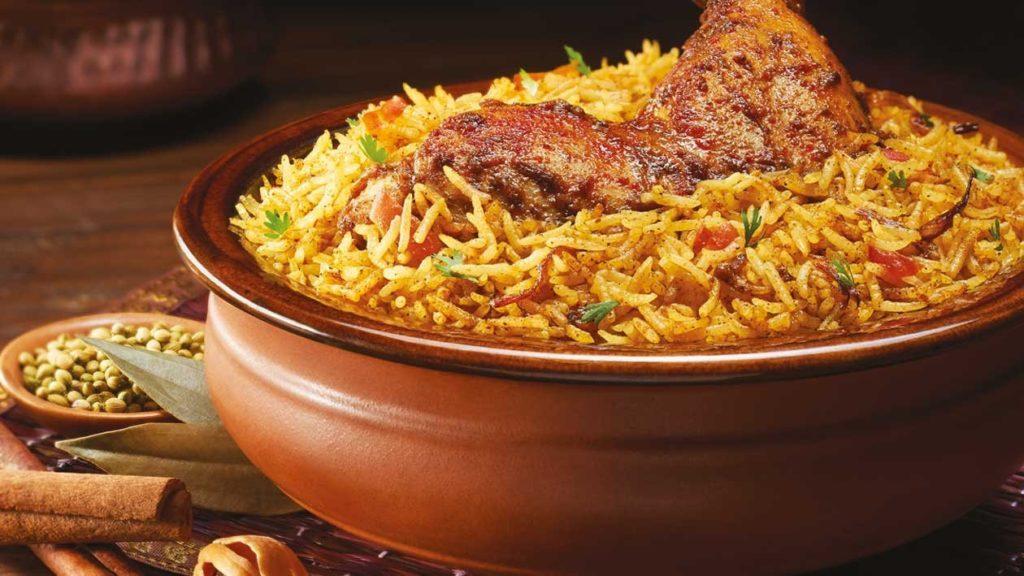
My Love Letter To Biryani

You are delicious and irresistible. You have countless admirers. It is not surprising that you are the undisputed king of good food. God bless the Mughals for introducing you to India. 

I look forward to Ghafoor aunty’s dishes every year during Ramzan only for you. Chicken, mutton, and rice are your key ingredients. Your best avatar emerges when both cook together in their raw forms. The juices from the meat enter every grain to endow them with a rich flavour.

Most restaurants in Hyderabad have mastered the art of preparing you. But it is only Bawarchi that continues to do justice to your gastronomic potential. When I was in Hyderabad, I would buy a packet of you from Bawarchi on my way home from work on Fridays. 

As a child, I have fond memories of feasting on you with friends whenever I got the chance.

When I covered food festivals as a reporter for TV9, my crew and I ate dinner following the shoot. I remember how my cameramen would ignore everything else to relish you. I don’t blame them because your popularity knows no bounds.

Once I graduated from college, I had to avoid you to keep my weight in check. I missed eating you those years. But I would sometimes cheat to make up for weeks of deprivation.

I always recommend you to people who have never tried you. I am sure you will not disappoint them.

May you continue to tickle taste buds!

Halal Love Story : A Film That Keeps The Faith In Humanity

”Halal Love Story” is a movie about a group of Muslim men who want to make a telefilm to spread the teachings of their Islamic organisation. It captures the constant tension between halal (permissible) and haram (forbidden) and the Muslim community’s struggle with liberal values like democracy and equality. 

There are two movies being played out. One is the main movie and the other is the movie within the main movie that the characters (of the main movie) are attempting to make. 

A genuine creative process is not bound by any limits or rules. It does not fear religious or traditional repercussions. But the movie within Halal Love Story is bound by a halal script. For instance, the lead pair cannot be strangers; the script demands they know each other. It thus follows that the deeply religious Shareef (Indrajith Sukumaran) and his wife Suhara (Grace Antony) are cast in the lead role. The scenes between the two are laced with humour and make for an entertaining watch. The couple also shares some tense moments when Shareef resents Suhara’s superior acting skills, thereby affecting their on-screen chemistry. However, the two make up after Taufeeq (Sharafudheen), who is in charge of the film making, brokers a truce.

Grace Antony is easily the star of the movie, both within and without. She shines as Suhara, the subdued homemaker who blossoms as a fine actor on the sets. Indrajith Sukumaran’s performance as the well-mannered Shareef, who is forced to come to terms with his limitations, deserves applause too.

Other scenes explore the ambiguous definition of Halal and Haram. Raheem (Nazer Karutheni), the leading light of the local branch of the Jamiathu Ikhwan Al-Wathan organization, recruits screenwriter Taufeeq to pen the script. But the duo realises that a perfectly halal director is a rare commodity. They hence settle for Siraj (Joju George) , a non-believer who smokes and drinks. Like Shareef and Suhara, Siraj finds it difficult to keep his messy personal life out of the movie but eventually makes peace. 

Soubin Shahir does a cameo as a sound recordist and is responsible for most of the comedy. He shuts down an entire village, disallowing housewives from washing clothes and forcing people to freeze mid-step when he shouts ‘Silence’ for a perfect take.

Director Zakariya Mohammed has explored a bold theme in Halal Love Story. Firstly, narrating two movies, one within the other, needs skill and acumen. In addition to that, he has made a strong case for a middle ground between tradition and modernity. In the process, he has just tickled the ribs of, without laughing at, the scriptures. I would also prefix the movie with the term ”feel-good” because there are no losers. Everyone, despite their personal issues and ideological biases, evolves and grows in the process of shooting.

Halal Love Story’s storyline was a little too simple, just like the men who embark on making the movie within the movie. But given the challenging theme, it is possible Zakariya did not want to take a risk.

Halal Love Story has a loud and clear message, which is that when tradition and modernity collide, it is humanity that must triumph. 

Heart Needs Rebooting As System Crashes : C U Soon Movie Review

“C U Soon” is a movie about Dubai-based Jimmy (Roshan Mathew) who falls in love with Anu (Darshana Rajendran) after they meet on Tinder. Jimmy proposes to Anu on a video call as his family watches from across the world. His worried mother (MaalaParvathi) asks her nephew Kevin (Fahadh Faasil), a cyber sleuth in the US, to verify Anu’s antecedents.

Just when it seems that the couple is ready to take the next step, a twist emerges with Anu’s disappearance from Jimmy’s home. There is more to it than meets the eye, prompting the Sherlock Holmes in Kevin to come alive. His digital-forensic skills are used to the maximum.

The plot thereafter is predictable. However, the movie’s intelligent use of digital communication devices ensures the audience does not stop paying attention. Suspense is a by-product of the innovation.

The screenplay rests entirely on computer screens and mobile devices. The dialogue comprises of text messages or video chats. At any given point, there are two cameras at work – the one of the image capturing device connecting actors at two ends and the other of the master movie camera. Both complement each other without getting in the other’s way. Only editing of a high standard could have achieved that. 

Additionally, C U Soon captures technology’s tremendous scope in searching, finding and deliberating. One is amazed at the speed and efficiency with which Kevin deciphers the truth with his nimble fingers on the keypad. The film’s extensive use of Google searches, Maps, WhatsApp chats and Hang Outs reminds me of what someone once said, namely, that technology has made “knowing” irrelevant. After watching “C U Soon” I could not agree more.

For millennials familiar with mobile jargon, the title ‘C U Soon’ would make perfect sense and the screenplay seem natural. However, even for those not comfortable with dating apps or social media platforms, the movie manages to be engaging. 

Despite its unimaginative plot, I would commend Mahesh Narayanan for attempting such a challenging genre. The movie was made so that a set of film makers could earn money during the lockdown. Remarkably, they have not disappointed and the audience never feels the lack of sets, travel and exotic locales. Far from being a disadvantage, Social Distancing is used creatively. 

Fahad Faasil’s composure and subtle expressions complement Roshan Mathew’s impulsiveness. The latter’s fly-by-night love affairs remind you of the exuberance of youth. Darshana Rajendran deserves applause for a solid performance.

“C U Soon” is truly a movie meant for the lockdown period. In addition to teasing your brain and making you see film-making in a new light, it reminds you that movies offer a glimmer of hope in challenging times. 

“Gunjan Saxena- The Kargil Girl” Review

A4B032A0-C5F9-4964-B8F2-DDFE1A3D6200

Gunjan Saxena – The Kargil Girl, Sharan Sharma’s directorial debut is about India’s first female Air Force pilot in a combat role and the obstacles she faces in a male-dominated world.

There are two wars being fought. One is the Kargil War of 1999 between India and Pakistan. The other is Gunjan Saxena (played by Jahnavi Kapoor)’s personal battle against a world that refuses to believe in women. Whether it is the absence of toilets for female officers, a condescending flight instructor or a discouraging older sibling, Gunjan Saxena’s real battles are not on the front lines.

The movie begins with a nine-year-old Gunjan (Riva Arora) wanting to peep out of an aeroplane window, but not being allowed to by her older brother (Aryan Arora). When a young Gunjan says “Mujhe Pilot Banna Hai”, her brother sarcastically remarks “Mujhe Kapil Dev banna hai”.  Clearly, there is no dearth of negativity in Gunjan Saxena’s life. However, she pursues her dream with hard work and determination.

The turning point in the movie is the belan (rolling pin) scene between Gunjan and her father Lt Colonel Anup Saxena (Pankaj Tripathi). The father reignites in daughter the will to carry on chasing her dream when Gunjan is on the verge of giving up.

Gunjan Saxena’s father Anup Saxena is her bedrock of support throughout in a quiet and unassuming way. He is the hero in her life without whom she could not have scaled such heights, literally and figuratively.

When the older Gunjan asks her father whether joining the IAF because she is passionate about flying and not because of a sense of duty towards her country amounts to treachery, Anup Saxena replies that the armed forces do not need people who shout ‘Bharat Mata Ki Jai’. What they require are passionate personnel who do their work with honesty. This bold differentiation between passion and patriotism in an era when the two are prone to getting mixed up is commendable.

If one were to subtract the war backdrop from the movie, “Gunjan Saxena – The Kargil Girl” would resemble any workplace with its patriarchal biases. The daily struggle of ambitious women to prove their worth and the umpteen hurdles in their way sound eerily familiar.

Pankaj Tripathi says a lot with just his expressions; his brilliant acting skills are on full display despite minimum dialogue.

Gunjan Saxena’s mother (Ayesha Raza Mishra) dissuades her from chasing her dream. Her brother Anshuman (Angad Bedi) means well but sides with his mother. By the end of the movie, the two are forced to change their opinion on women pilots when they see Gunjan excel in her chosen role.

Jahnavi Kapoor does a fairly good job of playing Gunjan Saxena. Her lack of experience shows but is not glaring. Being a newcomer in the film industry, her performance is bound to get better with every movie.

Wing Commander Dileep Singh (Vineet Kumar Singh), Gunjan Saxena’s flight instructor at Udhampur, is condescending towards her. He introduces her to his male cadets as “Miss Badlav” in a tone that is far from complimenting. By the end, he is forced to swallow his pride.

The biopic is compact and neatly packaged. The cinematography is uncluttered. The scripting is not lazy with a clear focus on Gunjan’s struggle in the Air Force. No time is wasted on chest-thumping war scenes either. The Kargil war scenes are short and businesslike thereby retaining the focus on the pilot’s life. Clearly, content takes precedence over sensationalism.

Gunjan Saxena – The Kargil Girl is bound to inspire women who dare to dream big.

Shakuntala Devi : The Unseen Side Of A Brilliant Mathematician

844ABF71-F06D-4236-8CA8-E21AEC1346B0

Shakuntala Devi – The Unseen Side Of A Brilliant Mathematician (Review)

As the name suggests, Shakuntala Devi (played by Vidya Balan) is a movie about the math genius from Karnataka who enthralled the world with her numerical abilities. The film also explores Shakuntala Devi’s turbulent relationship with her daughter, father, mother and husband. 

Shakuntala Devi the movie traces the mathematician’s life and her transformation from a child in a poor Karnataka family to a superstar in the world of mathematics. Her abilities put her on par with the best and the brightest. 

Loud, bold and ambitious, Shakuntala Devi is like an untamed horse let loose on the racing track. She is a non-conformist who dares to enter and dominate the world of mathematics, traditionally a male bastion. She revels in the adulation she receives and is intoxicated by success. Her relationships with men enamoured by her brilliance defy social norms.  This is apparent when she advises her daughter Anupama Banerjee to find another partner as living with the same man can get boring.

Vidya Balan is a seasoned actress who does a brilliant job of playing Shakuntala Devi. She portrays how the mathematician lived life on her own terms despite the pulls and pressures of society. Her experience in Dirty Picture and Mission Mangal seemed to have served her well. She is the embodiment of a feminist dream-turned- nightmare as she resolves to fight gender inequality both at home and outside. This burning desire comes not surprisingly from her own lived experiences where she was pulled out of school, denied a normal childhood and used as a golden goose by her father.

Ironically, in trying not to repeat the mistakes of her parents, she goes overboard enveloping her daughter Anupama in a suffocating embrace. This makes Anupama resentful and leaves her longing for the freedom to be herself. Sanya Malhotra’s portrayal of Anupama is a brilliant performance by a rising star. When she announces in scene one that she is contemplating legal action against her mother, the audience has no choice but to remain glued to the screen for the remainder of the movie. Malhotra succeeds in playing Anupama who, quite unlike Shakuntala Devi, hates maths and abhors any comparison with her mother.

Director Anu Menon has tried to portray the black, white and grey of every character in Shakuntala Devi. To her credit, she is careful not to glorify or demonise anyone. Each character is shown playing their part as actors on a stage would. In fact, Vidya Balan refers to this Shakesperean quote in the course of the movie.

Shakuntala Devi’s personal life is not as precise as her number-crunching abilities. She is shown excelling as a mathematician but ”failing” in every other sphere. This inability to reconcile the personal with the professional is true of most successful people. However, while men have models they can emulate, women do not. The women thus end up paying a bigger price for success than men. Quite understandably, women’s personal lives are often at odds with their professional one’s. The movie proves that successful women do not inspire awe; they only end up looking like poor caricatures of their male versions.

Jishu Sengupta, who plays Shakuntala Devi’s husband Paritosh Banerjee and Amit Sadh, who plays Anupama’s partner are portrayed as gentle, caring and supportive husbands. Possibly the Director Anu Menon, who was obviously in awe of Shakuntala Devi did not want to waste footage on the men.

The ending is a bit contrived because Anupama comes to terms with her turbulent relationship with her mother when Shakuntala Devi abruptly reverses her decision to deny Anupama her share of the property. Love is seen sinking the duo’s differences.

Shakuntala Devi is a movie that has done justice to the mathematician’s life. It is a revelation for anyone who is unaware of her darker side and her tough childhood.

How The Covid 19 Lockdown Helped Me Quit Smoking

imagesI have been a smoker for the past fourteen years. I remember the day when I was offered a cigarette by a friend over a cup of tea in a Hyderabad restaurant. It was the end of a tiring day and my first puff seemed divine. It was relaxing, liberating and provided me with a release from a stressful and challenging work environment.

I was working as a journalist in TV9 in Hyderabad. It is an open secret that journalists are overworked, especially those in electronic media. And having attained seniority in the digital marketing team, I was expected to give more than one hundred per cent. This meant that I had to be sharp, quick and achieve targets on time. This added to my stress levels. I also realised why journalists are often seen guzzling alcohol at the press club. And why many of them die prematurely.

As smoking became a daily habit, many of my friends and colleagues ( who were shocked because I hardly seemed the kind who would go astray) tried to talk me into giving it up. They counselled me about the health risks associated with the deadly habit, but to no avail. I did my level best to kick the habit but would be back to square one each time. I badly wanted to quit too because, in addition to the health risks, I was beginning to face stigma from friends and family alike. I recall one of my colleagues saying ”Yeh Kanishka tho phaltu go gaya”, which in English means ”Kanishka has turned out to be a good for nothing oaf”. Such comments dented my self-esteem and confidence but did nothing to help me quit. Besides, I was not doing well professionally and was using cigarettes to vent my frustration. I was caught in a vicious cycle.

As the years rolled on, my name became synonymous with smoking, especially at work. If someone referred to me, they would say ”Oh yes, I know Kanishka. He’s the one who smokes like a chimney, right?” I was but a mere shadow of my former self, both physically and emotionally. I knew deep down that it was important to quit, but hadn’t the faintest idea of how to go about it.

As I have mentioned before, my professional life was not going well either. Fortunately, problems on the work front sorted themselves out in a little while. But I remained a smoker. I think the main reason I was not able to quit smoking, even though I was doing well at work, was the stress. Long working hours coupled with the pressure to perform made me turn to smoking for release.

I made a major career move in 2018. I bid goodbye to my TV9 job and shifted to Bangalore to work at the Rangoli Metro Art Center. I then managed to cut down my smoking to five cigarettes a day. On a visit to Hyderabad once, (in Nov 2019 I think ), I met my former colleague, the one who had made the ”Phaltu” comment. He asked me if I still smoked, to which I replied yes and added that kicking the habit seemed like a daunting task. He advised me to keep trying and not give up.

A few days into the lockdown, cigarettes were in short supply. On the advice of my mother, I began breaking whatever cigarettes I had left into two and smoking just one half, instead of the usual full cigarette, every time. I then realised that if I could bring down my smoking to three cigarettes a day, then quitting for good should not be difficult. And lo and behold, as I write this, it has been eight days since I smoked! And I am also able to resist the temptation whenever I see a shop that is open and selling cigarettes.

I am now able to smell and taste things better. I am able to meet people confidently without worrying about smelling bad. My appetite is back to normal and I am sleeping well. I haven’t felt so good in a long while. Yes, there is always a risk of a relapse once the lockdown ends, but I am confident that with a bit of will power I will stay on course.

I think more than the actual work-related stress, it is the maladaptive ways of dealing with the stress that is a cause for concern. Habits like smoking and drinking are easy, albeit dangerous, ways of coping. And once you get used to unwinding over a drink or a smoke, it becomes difficult to break out of the cycle.

I am glad that I have finally managed to quit smoking and am back on the track to good health. If anyone of you have similar issues, please remember that quitting smoking, alcohol or drugs is possible. It is certainly not easy, but with professional and family support, the battle can be won.