The magic of Buddhavanam

It is night, and as I sit in the verandah, I hear the buzz of crickets. Silence envelops the Haritha Vijay Vihar resort like a majestic shroud. Twenty feet away, the vast expanse of the Nagarjuna Sagar lake begins. Swapna is insde the room working on her laptop, while I try to get down to serious writing. Let me start with the events of today.

I wake up at 8 for a walk. The cool breeze, tall trees and leaf-lined roads provide the perfect excuse to step out for a date with nature and restart my exercise routine.

Kishore, the auto-rickshaw driver we appointed to ferry us around, is on time. He was planning to come earlier, but I ask him to defer the day’s sightseeing by a couple of hours, as I had to complete some tasks. His enthusiasm and keenness to show us around Nagarjuna Sagar is refreshing.

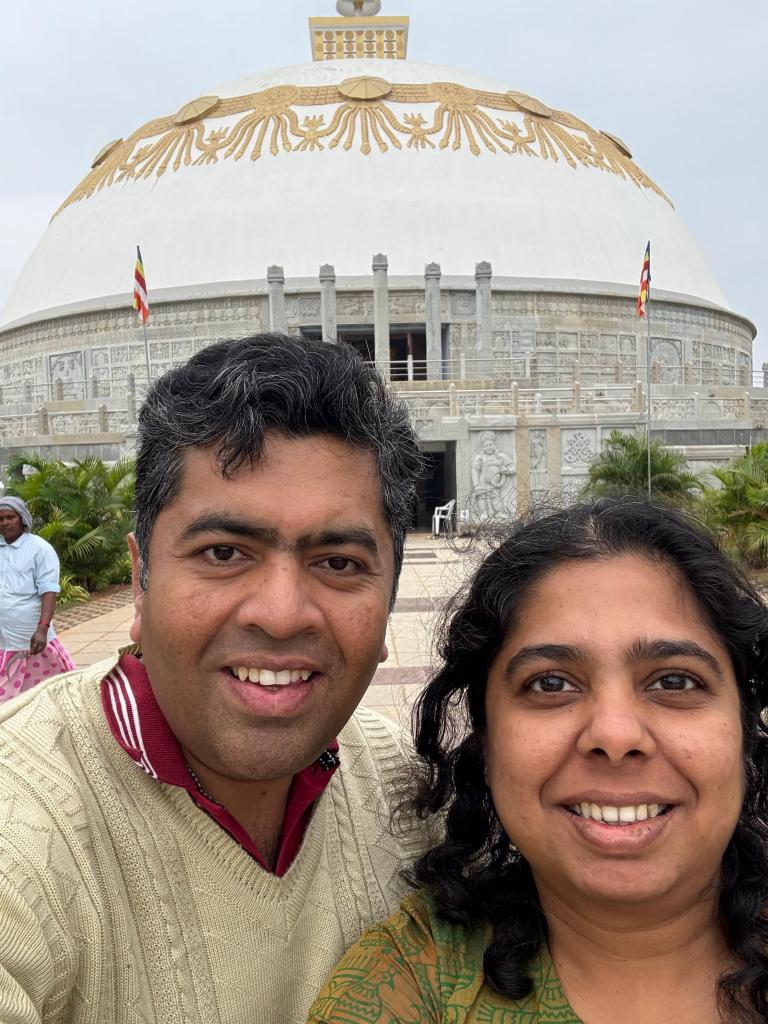
Once we get inside the autorickshaw, Kishore drives us to see Buddhavanam, a Buddhist Heritage Park in a place called Sunkishala. Buddhavanam consists of a Maha Stupa, 42 metres in diameter, at the centre, with other architectural tributes to Buddhism around the main dome. The middle dome has two floors, with the upper floor housing a meditation room, whose tranquility is like a balm for stressed city dwellers. The intricately carved walls depict the Jataka Tales and other significant events of the Buddha’s life. 

Overwhelmed by the sheer size of Buddhavanam, Swapna and I decide to explore one more spot in detail, the Stupa Vanam. The Stupa Vanam consists of replicas of stupas from different parts of India and the world. In the India section, we see replicas of the Sanchi Stupa, the stupa at Sarnath, the one at Amaravati, and the stupa in Samath. Having walked for several hundreds of metres, we dread walking further. However, our shared love for history makes us forget our fatigue and continue with exploring. 

Adjacent to the Indian stupa replicas lie their counterparts from Pakistan, Afghanistan, Nepal, Tibet, Mayanmar, Cambodia, South Korea and Sri Lanka. The difference in architectural style of each stupa is apparent, helping us see how Buddhism and the local cultures interacted, fed off each other and produced a syncretic result. While the Pakistani and Afghani stupas showed the influence of Islamic architecture, those from Nepal & Tibet and Cambodia & South Korea had South Asina and Southeast Asian features. 

The Buddhavanam is a microcosm of Buddhist architecture and culture from different parts of the world. It helps you to compare the architectural styles of Buddhist structures, as they vary from state to state and country to country. The vast exhibit proves how popular and firmly entrenched Buddhism was in India for close to a millenium. It also showcases the spread of Buddhism outside India, made possible by rulers like Ashoka, Kanishka, and others. 

‘Dhadak 2’ Review: A Bold, Unflinching Look at Caste 

Dhadak 2 is Shazia Iqbal’s Hindi adaptation of Mari Selvaraj’s Tamil film ‘Pariyerum Perumal’. It portrays an inter-caste couple’s fight against caste prejudice. 

Neelesh (Siddhant Chaturvedi), a Dalit student of law, has a simple and straightforward goal: to study hard, become a lawyer, and lift his family out of poverty. He avoids political activism, lest it derail his long term plans. He finds an empathetic friend in Vidhi (Tripti Dimri), who helps him understand the subject. And, like what happenes in most college friendships, theirs deepens into love.

Neelesh’s subservience and timidity get him nowhere: he is constantly reminded of his place in the caste hierarchy, whether in college or at social gatherings. Neither can he claim his right as a student, nor can he escape casteist taunts. 

His struggle is reminiscent of real-life Dalit students who paid the price for speaking out. The case of Senthil, the Dalit student in the University of Hyderabad who took his own life, comes to mind instantly. And when Shekhar (Priyank Tiwari), Neelesh’s contemporary in college and a fellow Dalit, resorts to the extreme step after being suspended for protesting, one cannot miss the resemblance with Rohit Vemula.

When his face is disfigured by upper caste students in college, the lion in Neelesh awakens. Siddhanth Chaturvedi plays Neelesh’s transformation into a confident and assertive individual, who will not take injustice lying down, convincingly.

Like Siddhant Chaturvedi, Tripti Dimri does full justice to her role. She is not the hero’s usual sidekick and carves out an identity and place of her own. Bold and outspoken, she doesn’t hesitate to ask uncomfortable questions, even if that means challenging her family’s honour. 

Full marks to Shazia Iqbal for boldly engaging with a sensitive theme like caste. She highlights the humiliation Dalit students face in our universities, capturing the stigma in all its rawness. She also addresses the problematic issue of upper caste family honour with the same brutal honesty.

Dhadak 2 is powerful in its treatment of caste. The crisp narrative, sharp dialogues, and engaging story enhance its appeal. It is a must-watch that doesn’t just entertain but compels reflection. The quote at the beginning of the movie sums it up best:

“When injustice becomes law, resistance becomes duty”

Food for the stomach, music for the soul

With Independence Day falling on a Friday, we realised that the weekend would get extended by a day. Having more time on our hands, we decided to binge-watch Borgen, play badminton, and read on the first two days of our three-day break. Sunday could be spent visiting the Indian Music Experience Museum at JP Nagar. Swapna had mentioned it to me earlier, and I was curious about what made the place special.

We began the day with my Tabla class at Malleshwaram. Swapna prefered to soak in the nature at the public park nearby as I drummed away under my Guru’s guidance. After an hour of practise, I was done and joined Swapna at the park. It was time for lunch, so we hurried to Halli Mane in an autorickshaw. Halli Mane, meaning ‘Village Home’ in Kannada, is a popular restaurant serving South Indian food in the heart of Malleshwaram. Eager to relish the tasty food, we bought ourselves a special weekend meal each. As expected, we were served a rich variety, from a welcome drink, starters, five types of main course, and three kinds of dessert. We ate to our heart’s content because, after all, it is not everyday that we get to eat good food.

After lunch, our expedition to the Indian Music Experience Museum began. Located at JP Nagar, the museum begins by highlighting the music in our everyday lives – the chirping of crickets and birds to the noise of busy roads. It then takes you through the history of Indian music, starting from the first hymns in the Sama Vedas composed two thousand five hundred years ago, their evolution into the Carnatic and Hindustani forms, the influence of Western and Persian music on Hindustani, to the rise of popular film music, and more. The 360 degree view of Indian music at the museum is a visual and auditory feast. Whether you are a professional or amateur, you are sure to find something about music that interests you.

Back home after the eye-opening visit to the Indian Music Experience Museum, Swapna, Amma and I ended the day the way we began the weekend – by watching one more episode of Borgen.

Review of The Hunt – The Rajiv Gandhi Assassination Case

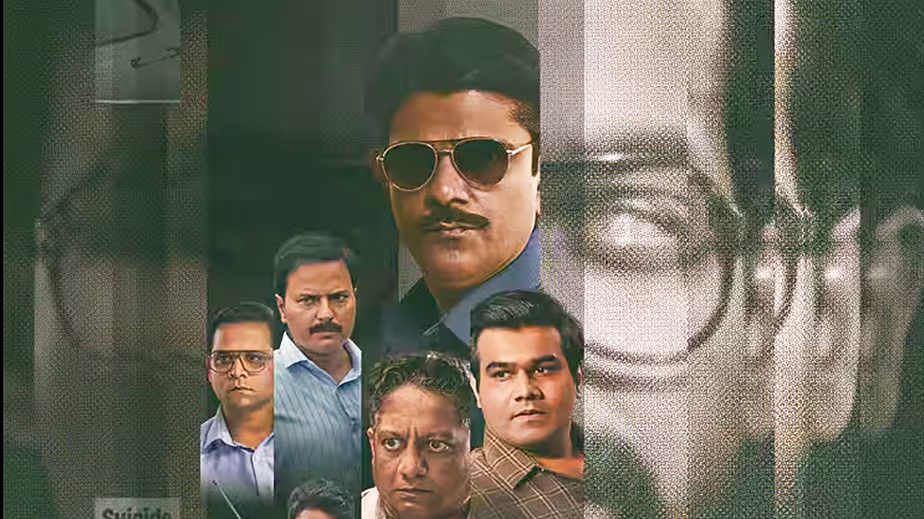
‘The Hunt – The Rajiv Gandhi Assassination Case’, is an OTT series about the probe into the assassination of former Prime Minister Rajiv Gandhi in Sriperambdur in 1991. As the country comes to terms with the brutal murder, a Special Investigation Team (SIT), set up to nab the culprits, swings into action.

Establishing the LTTE’s role in the assassination is not difficult. The real challenge lies in nabbing Shivarasan, the mastermind of the plot. Amit Sial plays D.R. Karthikeyan, the lead investigator. In the words of his superior, Karthikeyan’s is the toughest job in the world. He faces pressure from all quarters – politicians, pro-LTTE Tamils, and a restless team. Yet, with a restrained demeanour, Sial impresses as the stoic Karthikeyan who rises to the challenge and keeps his team united & focussed on the ultimate aim. He is the fire that keeps the team’s spirit burning and the officer who leads by example. 

While showcasing the brilliance of the SIT, The Hunt says a lot about the support that the LTTE enjoys in Tamil Nadu. According to Inspector Ragothaman, the only Tamil officer in the SIT, “One man’s terrorist is another man’s freedom fighter.” A small sentence that speaks volumes.

Director Nagesh Kukunoor manages to evoke drama, intrigue, and suspense. Every scene captures the tension of the investigation, making you want more. The sharp editing and concise script also do their bit to engage you. I also laud Kukunoor for ending the series on an unresolved note. Yes, the SIT nabs Shivarasan and his team of LTTE operatives, but, as officer Amit Verma puts it, with Shivarasan’s death, the truth is also buried. The audience grapples with more questions than answers, a lot like life…..

Conclave Movie Review

Directed by Edward Berger and based on a novel by Robert Harris, Conclave is a movie about the Papal election. As the cardinals congregate at the Vatican to select a successor to the late Pope, a drama unfolds.

Cardinal Lawrence (Ralph Fiennes), the Dean of the College of Cardinals and in charge of the election process, plays the central role. Although not a serious contender for Pope, his speech at the outset of the election is revealing. In that speech, he urges his peers to select someone who may be flawed but has the humility to ask for forgiveness and move on. According to him, absolute certainty is the enemy of faith – even Jesus Christ was uncertain till the very end of his life.

As the election process begins, a trail of deep secrets emerge. These revelations showing the Cardinals in poor light can shake the foundations of the Roman Catholic Church. Yet, despite the sensational nature of the revelations, Cardinal Lawrence deals with these crises in a mature and wise manner. Justice is done and God’s will prevails.

The Conclave boldly links the Roman Catholic Church with political divisions of the kind we read about in newspapers. Reacting to a suicide bombing, Cardinal Tedesco (Sergio Castellitto) lashes out at Islamic Fundamentalists without naming them. In a speech laced with hate and sarcasm, he calls upon Christianity to fight the real enemy, and ridicules the liberals for their pusillanimity. The Right-Left divide at the Catholic Church couldn’t be more stark.

While the movie shines a torch on the political divide within the Church, it could have gone a step further by fleshing it out. Unfortunately, it resorts to a linear narrative by showcasing the liberals as sophisticated and painting the conservatives as brutish. This one-sided representation ignores many nuanced complexities.

Given that every character in ‘Conclave’ is associated with the Church, the movie is understandably bereft of drama. Yet, stellar individual performances aided by a sharp script compensate for this gap, gripping you from the word go.

Spotting the Tiger

We had an inkling of the tiger’s location,
When the deer ran in the opposite direction.
The bus screeched to a grinding halt,
For a glimpse for every tourist worth his salt.

We decided to play the waiting game,
To catch the tiger in our camera’s frame. 
That the fruits of patience are always sweet,
Is something we were taught and believed.

We kept our fingers crossed, 
Oblivious of the time and lost. 

After hours of patient waiting,
And hard and studied gazing,
We saw the tiger quench its thirst, 
Causing within an adrenaline burst.

Big and small, old and young,
Every tourist exclaimed at once.
Some jumped out of their seats,
Others felt weak in their knees.

The Tiger showed such grace and poise,
We all took a bow – we had no choice.
When the jungle’s king walks proudly through, 
You bow your head — it’s only due.

ADIEU, KARWAR

Today was the last day of our Karwar visit and our only chance to visit the Rock Garden & Warship Museum. As our bus was in the evening, we used the morning to explore these two places. 

Located on the Rabindranath Tagore Beach, the Rock Garden showcases the lives of Karnataka’s people. From Haliyal in the north to Bhatkal in the South, every tribe finds a worthwhile mention.

When you enter, a mural sculpted like a fisherman’s family celebrating a catch welcomes you. Further inside, you see sculptures of people farming, fishing, and animal rearing. They are so intricate and life-like that you feel they are talking to you, inviting you to be a part of their lives. Stone plaques with details provide a deeper understanding for the curious visitor.

The Warship Museum, located next to the Rock Garden, showcases the historic INS Chapal. Dummy guns and rocket launchers on the outside highlight the Navy’s firepower. The interiors, on the other hand, stand out for their rich detail. As you enter, mannequins dressed as the Captain, Sailors, and Doctors greet you. A TV room, a strategy room, a medical unit, and others recreate their lives, a blend of hardship, adventure, and fun. 

Once done with the sightseeing, we headed back to the resort. On the way, we bought Apples and Oranges for our trip home.

We boarded the bus back to Bangalore at 6. Reflecting on our stay, we felt grateful to have experienced a slice of Karwar’s rich history, culture, and natural beauty. With its pristine beaches and lush forests, Karwar is the perfect destination for travellers looking to unwind.

While researching before our visit, I remember stumbling upon some interesting information: Rabindranath Tagore describing Karwar as the ‘Kashmir of South India”. This description puzzled me then, but not anymore…..

SEASHELLS AND CALAMARI

Palolem Beach had left a deep impression on Swapna and me, so we decided to spend the day there. Like earlier, we boarded a bus to Canacona from Karwar and, upon reaching, walked down to Palolem Beach.

Since the sun was blazing, we postponed the swimming to the evening. But we wondered how we would spend the day. We then spotted reclining chairs under an umbrella outside a shack. This gave us an idea. We could spend the morning relaxing on them, soaking in the warm sun without overexposure. We requested the shack’s owner to let us use them, and, to our delight, he agreed. But he had a condition: we had to eat lunch at his restaurant. We agreed.

Soon, it was time for lunch. As I flipped the menu, I remembered Sandeep asking me to try Calamari. Calamari is a Konkani dish made by cutting squid into rings and then breading & frying them. Eager to experiment, I ordered it. Swapna was keen on prawns and ordered a plate. 

Cooked in cheese & corn flour and served with French Fries, the Calamari was delicious. I relished every bite as it melted in my mouth like butter. Swapna, seeing me enjoy the Calamari, felt a FOMO (a marketing term that stands for Fear of Missing Out). She liked them so much that she forgot about the prawns.

At 4, the sunlight faded. We entered the sea but limited ourselves to the shallow parts. The lifeguard on duty warned us against going too deep. Yet, even that experience was fulfilling as the water kissed our skin and rejuvenated us.

We spent the final hour at Palolem Beach shopping for necklaces made of sea shells. We wanted to gift Amma something authentic from Goa, and this was the perfect opportunity. We also bought some elephant-shaped fridge magnets, also made from sea shells.

DAY 4 AT KARWAR

Although we started sightseeing late in the afternoon, the day was, by far, the most enjoyable of our Karwar stay. The autorickshaw driver first took us to Bhimkol Dam, a 45-minute drive from Sterling. Bhimkol is a village in Uttara Kannada, and the dam rests on the River Kali, the district’s lifeline. 

The Bhimkol dam provides irrigation water but also doubles as a tourist spot. Nested within wooded hills, it is calm and serene. Its picturesque beauty helped us relax, and, unsurprisingly, the place is a hit with tourists wishing to unwind. 

Since Kali was not in spate, we could wade through it at a shallow point. The water was crystal clear, with no trace of plastic bottles or cigarette buds.

While conversing with a local, we learnt that Bhimkol’s residents depended on agriculture for a living. Unfortunately, floods have forced them to seek out newer avenues. Children do their schooling & college at Karwar and then migrate to Goa for employment. 

Once done with Bhimkol, we proceeded to the clean and quiet Manjali Beach. Upon arriving, Swapna changed into her costume to take a dip. I saw the glee on her face as the waves crashed against her body. Nothing came between her and the water, and she swam to her heart’s content.

DAY 3 AT KARWAR

We woke up late, feeling refreshed after the exhausting trip to Goa the previous day. We were hungry but wanted to find a cheaper option for food. Luckily, we discovered an Udupi restaurant next door and headed there for breakfast.

The dosas at the Udupi restaurant were crisp and golden brown. The cook had roasted them to achieve the perfect taste and colour without overusing oil, a testament to his skill and experience. Swapna and I relished the meal and ended it by sharing a plate of Kesari Bath.

After the meal, we returned to our room and decided to spend the morning at Tagore Beach, around five kilometres from Sterling. We had heard of the beach’s magnificent sunrise and were keen to witness it in person. Luckily, we found an autorickshaw driver.

Unfortunately, by the time we reached Tagore Beach, the blazing hot sun was out in full force, dashing our chances of a pleasant view. We ate quickly at a restaurant nearby and returned to the resort for a siesta. 

In the evening, we returned to Tagore Beach. This time, we were lucky. The quiet sunset, the sea, the clouds, and the cool breeze did wonders for our mood, uplifting our sagging spirits. We captured photographs of the setting sun in the background. We collected shells embedded within the sand, appearing whenever the water receded. 

After two hours at Tagore Beach, we returned to the resort. At the resort, we joined other tourists in watching a documentary on the US Navy. The film highlighted the massive sea, air, and stealth power of the United States, giving the audience an insider’s view of warships, aircraft carriers, destroyers, and reconnaissance submarines. 

Having spent most of the day outside, we returned to our rooms and went to bed, eagerly anticipating the adventures that awaited us the next day.